Showing posts with label Dave Augustyn. Show all posts

Monday, April 16, 2018

Pelham’s 2018 Blended Residential Taxes Up 1.9% -- 12 Year Increase Less Than Inflation

If you pay your property taxes by installments, you will know that the second installment of your 2018 property tax bill comes due in two weeks (April 30). With this deadline approaching, I wanted to tell you about Pelham’s 2018 blended residential property tax increase – at 1.9% – and also to compare with other Cities and Towns.

You will recall that the amount of property tax you pay to the Town of Pelham, to the Niagara Region, and to the Province (for Education) is not solely based on the Market Value Assessment of your property by the Municipal Property Assessment Corporation (MPAC); one must multiply your assessment by each of these three tax rates and add them up for your total bill.

With both the Region and the Province making some policy changes and adjustments for rates and tax ratios, we now know that the combined property tax increase for an average residential property (which is valued at $328,138) in Pelham will be 1.9% for 2018. That means an average residential tax bill of approximately $4,187 or an increase of about $79 over last year. (Because of some rates changes, that’s actually a bit lower than the 2% to 2.3% range that I reported to you in February.)

You can consider this $79 or 1.9% a “pocket-book” increase – an increase in the amount it cost an average residential property owner because it’s adjusted for the average MPAC increase in Pelham.

Since Pelham’s portion of your property taxes represents roughly 39% of the total bill, the Town will make use of about $1,618 of the $4,187 for the average residential property.

Who gets the most? The Niagara Region will get about $2,012 or 48% of the total amount. Meanwhile, the Province will receive the remaining approximately $558 (or 13%) to help fund education.

How do we measure whether the increase is “affordable” or not?

One independent way to judge whether Pelham’s taxes are “affordable” is to compare with inflation. For example, the Bank of Canada calculated that, over the last 12 years (February to February), inflation increased the value of goods and services by 22.7%.

Over the same period, Pelham’s combined taxes for the average residential property increased by 22.0% – a bit lower than inflation. Essentially, that means that the average home is paying the same level of taxes in 2018 that they did in 2006!

And, this 22.0% over 12 years includes so many improvements in our community – from renewed Downtowns in Fonthill and Fenwick, to new Fire Halls in Fenwick and North Pelham, from nine renewed playgrounds, to a new skatepark and a new dog park, from a renewed Maple Acre Library to a renovated Old Pelham Town Hall, from 15 km of new sidewalks and 5 km of new trails to the new Meridian Community Centre. And, the list of other infrastructure and services goes on and on.

Another way to judge would be to compare with other Niagara Cities, Towns, and Townships.

Last Fall, the Region published a corrected table of non-blended property tax increases from 2010 to 2017 for local municipalities. If you start at zero in 2010 and add up the cumulative increases, Niagara Municipalities increased their property taxes an average of 35% over those eight years.

Pelham stands as the forth lowest because ours increased 30% – including an increase in funding for the Community Centre in 2016. That’s 14% below the average increase of other Cities and Towns for the same period. Three other growing Towns – Grimsby, Niagara-on-the-Lake, and West Lincoln were lower than Pelham since 2010.

Pelham Council and I continue to work together with staff to ensure that changes in property taxes only minimally impact you and your neighbour while improving the level and quality of services in the Town.


Please check out historic charts or read past columns at www.pelhammayordave.blogspot.ca. Please contact Mayor Dave at mayordave@pelham.ca.

Sunday, November 13, 2016

From “Sprawl” to a “Complete Community”

I keep the “Sprawl Repair Manual” by Galina Tachieva on my desk at home. The work “presents a comprehensive methodology for transforming sprawl” along with “implementation techniques” for “rebalancing suburbia.”

Why? Well, I hate to point out that much of Pelham developed as sprawl.

During the late-1800s and early-1900s, development in the former Township of Pelham and Village of Fonthill grew along traditional coach routes (like Canboro Road) and at crossings along the TH&B (through Fenwick) and NS&T (through Fonthill) railway lines.

But, the advent of the automobile quickly changed all that.

For example, only in a car-centered-culture would one build a high school on some of the best tender fruit land and on a (then) Provincial Highway.

Similarly, prior to the hundreds of homes around it, the Pelham Arena was erected in the mid-1970s in a farmer’s field and far from restaurants and retail.

In fact, much of Pelham’s previous residential development sprawled across farm lands and forests. These now-mature residential neighbourhoods from the 1970s and 80s contain more than 50 cul-de-sacs or courts! That’s quite different than traditional neighbourhoods of College, Emmett, Elm, Burton and Chestnut streets.

Previous Councils also expanded the Town’s “urban boundaries” – the areas in which one can develop. The +500 acres in East Fonthill and “Lookout Ridge” were added in 2000. Significant developable lands in Fenwick – from Cream to Balfour and between Memorial and Welland Road – were added in 1990.

Once approved, these urban-land-rights last forever, guaranteeing a development future for Pelham.

Given this history, how does one “repair” the sprawl and foster a more “complete” community?

We started by revitalizing Downtown Fonthill and Fenwick; in addition to rebuilding the streetscapes, one-third of the buildings on Pelham Street have recently improved their façades and added residential units.

We’ve also encouraged walking and cycling by building more than 13 km of sidewalks, 9 km of bike lanes, 7 km of trails, and 5 crosswalks. Now – 53 years after it opened – we’ve approved extending a sidewalk to Crossley. We’ve also discouraged car use by initiating Pelham transit.

We approved plans for East Fonthill that include wide-sidewalks and trails and a road network that links to existing streets; to enable these plans, we’ve even removed houses were future streets will go.

We’ve insisted on street-facing commercial development and on as pedestrian-friendly-as-possible parking. We continue to call for rear-lanes and we protected key environmental features.

Instead of consolidating services into a central building, we’re revitalizing the Maple Acre Library. And, we’re constructing the new Pelham Community Centre near other amenities – like stores and restaurants, and a future medical centre, retirement home, and other “mixed-uses.”

Finally, we remain committed to the Town’s urban boundaries and increased the protections on the Fonthill Kame.

Correcting Pelham’s sprawl isn’t easy, but Council and I will persevere toward that goal.

Sunday, August 14, 2016

Kame, Ridgeville, Funding and Transit at AMO Conference

This week, Councillors Accursi and Durley, Town CAO Ottaway, and I will attend the Association of Municipalities of Ontario (AMO) Conference in Windsor. The annual three-day conference offers a range of learning sessions and networking opportunities and organizers expect more than 1,300 delegates.

While at AMO, your Pelham representatives will also directly advance your interests with the Provincial Government through meetings with various Ministries.

First, we will meet with Kathryn McGarry, Minister of Natural Resources (MNR), about increasing the protection of the Fonthill Kame. For the last eight years, we effectively used AMO and “Niagara Week” meetings to urge the Province to enhance the Area of Natural & Scientific Interest (ANSI) protections of the Kame. For the last couple of years we thanked the Provincial Government for finalizing those protections in late 2013. Like last year, we intend to ask MRN to add more of the Fonthill Kame to the protections offered by the Niagara Escarpment Plan.

Similarly, we will be meeting with the Bill Mauro, Minister of Municipal Affairs, about the same topic and more. You see, the Province is seeking final input on their "Co-ordinated Land Use Planning Review" -- a review of the Growth Plan for the Greater Golden Horseshoe, the Greenbelt Plan, the Oak Ridges Moraine Conservation Plan and the Niagara Escarpment Plan (NEP). These planning documents work together to "manage growth, build complete communities, curb sprawl and protect the natural environment." In addition to asking for adding additional Fonthill Kame lands under the protection of the NEP, we want to thank the Minister for fixing an historic planning error regarding Ridgeville. Since the Greenbelt Plan excluded the Hamlet of Ridgeville more than 10 years ago, the coordinated review is proposing that it be included and recognized.

Next, we will meet with Eleanor McMahon, Minister of Tourism, Culture & Sport, about the Pelham Community Centre and Provincial funding opportunities. Since Minister McMahon recently attended the launch of Pelham Summerfest, we will also be updating her about the successes of our signature, four-day festival.

Finally, we will meet with Daiene Vernile, MPP & Parliamentary Assistant to Minister of Transportation (MTO), regarding our Community Transportation Pilot Project. Thanks to $100,000 of Provincial funding, the Town has operated Pelham Transit for nearly a year as a pilot program. We will again thank the MTO for the grant, talk about plans for Regional Transit, and outline the need for ongoing sustainability of transit.

Please be assured that Council and I will continue to take all opportunities to promote Pelham’s interests to the Provincial Government.

Sunday, April 17, 2016

Pelham’s 2016 Residential Taxes Increases by 2.4%


Two months ago I wrote about how Council approved our 2016 Operating Budget. Since the Province issued the property tax rate for Educational purposes last week, I can now provide you with an update on the total 2016 residential property tax bill.

You will recall that the amount of property tax you pay to the Town of Pelham, to the Region, and to the Province (for Education) is not solely based on the Market Value Assessment of your property; we multiply your assessment by each of these three tax rates and add them up for your total bill.

The Municipal Property Assessment Corporation (MPAC) – the Provincial body that sets a value your home and property – re-evaluated and assessed all properties in the Province as of January 1, 2012. While this amount will be used as the value of your home in 2016, MPAC phases in any assessment increases evenly over a four-year period. The Town uses that changing assessment value when we calculate your property taxes each year.

When Town Council approved our 2016 Operating Budget in February, we didn’t know neither the Regional nor the Provincial rates.

Now that the Region approved the property tax rates and ratios last month and that the Province set their rate last week, we know that the combined property tax increase for an average residential property (valued at $309,200) in Pelham will be 2.4%.

Please note that this 2.4% is the “pocket-book” increase – the amount it cost an average residential property owner by adjusting for the average MPAC increase.

(I am sure that you would be interested to know that approximately 1.1% of this 2.4% is attributable to the one-time increase for the Pelham Community Centre.)

How do we measure whether that amount is “affordable” or not?

One independent way to judge whether Pelham’s taxes are “affordable” or not, is to compare them with inflation. For example, the Bank of Canada calculates that, over the last 10 years, inflation increased the value of goods and services by 17.7%. Over the same period, Pelham’s combined taxes for the average residential property in Pelham increased by 17.4% -- slightly less than inflation. And, this includes the amount already included in the Town’s 2016 budget to help fund the Pelham Community Centre.

Pelham Council and I continue to direct staff to ensure that we only minimally impact you and other property tax-payers while we increase the level and quality of services to the Town.

Sunday, September 6, 2015

Help Increase Protection of the Kame

As I wrote about in the spring, the Ontario Government is reviewing the Greenbelt Plan, Growth Plan for the Greater Golden Horseshoe, Oak Ridges Moraine Plan, and Niagara Escarpment Plan.

In April, I wrote to the Expert Advisory Panel overseeing this Review and implored them to increase the protection of the Fonthill Kame. I recently sent another letter to the Panel, and I am hoping that you will too! (Please click here for a copy of my letter.)

The “Fonthill Kame-Delta” is Niagara’s rare, 75-metre-tall, 1,000 hectare landmark that was formed by retreating glaciers 13,000 years ago. As the “hill” in Fonthill and Shorthills and the “ridge” in Ridgeville, the Kame boasts the highest point in the Niagara Region and serves as a significant water recharge area and forms the headwaters of the Twelve Mile Creek. Further, the Kame’s microclimatic and soil conditions create an ideal environment for tender fruit including peaches, sweet and sour cherries, and plums.

The Ministry of Natural Resources (MNR) identified the Fonthill Kame as provincially significant in 1976 and as a Provincial “Area of Natural and Scientific Interest” (ANSI) in 1988 as a way to help restrict development. The Province also protected parts of the Kame with general provisions in either the Niagara Escarpment Plan or specific provisions in the 2005 Greenbelt Plan.

And, after considerable public feedback, research and scientific evaluation, MNR confirmed a new ANSI boundary for the Kame in October 2013.

As the Province reviews the Greenbelt Plan and the Niagara Escarpment Plan, they could inadvertently lessen these protections.

That’s why I wrote the Expert Panel in April and urged them to reinforce the ANSI re-designation by increasing the protection of the Fonthill Kame in their land use Plans.

During the summer, Niagara Region approved maps and commentary as part of their submission to the Expert Panel. In that submission, Regional Council reiterated its request that the lands forming part of the “total morphology” of the Fonthill Kame be recognized and protected. (Please click here and see page 3 and 4 and appendix of Regional report. [Large 11.3MB.])

In fact, the Region suggested that lands as identified through scientific study by expert Dr. Menzies be added to the Niagara Escarpment Plan for increased protection. (For a map of those lands, please click here. [Please note, it would exclude lands in the Fonthill Urban Area and in the Ridgeville Hamlet.])

And, at the recent Association of Municipalities of Ontario (AMO) conferences, Town Councillors and I asked the Ministry of Natural Resources representatives to add Fonthill Kame lands to the Niagara Escarpment Plan area. (For more about this and a copy of our presentation, please see my recent column.)

Now, I am asking you to provide similar feedback to the Panel this month; please let them know that you are interested in protecting the Kame via the Niagara Escarpment plan to help curtail further aggregate extraction or development.

Please email your comments to landuseplanningreview@ontario.ca or send mail to:
David Crombie, Chair
Land Use Planning Review, 
Ministry of Municipal Affairs and Housing, 
Ontario Growth Secretariat, 
777 Bay Street, Suite 425 (4th floor)
Toronto ON M5G 2E5.

Thank you, again, for helping to further protect the Fonthill-Kame so that its distinctive features, microclimatic and water recharge functions might be better safeguarded for future generations!

Sunday, August 16, 2015

Kame, Hydro, and Public Transit at AMO Conference

This week, Councillors Accursi, Durley, King, Papp and Rybiak and I will attend the Association of Municipalities of Ontario (AMO) Conference in Niagara Falls. The annual three-day conference offers a range of learning sessions and networking opportunities and organizers expect more than 1,600 delegates!

While at AMO, your Pelham reps will also directly advance your interests with the Provincial Government through meetings with various Ministries.

First, we plan to meet with Kathryn McGarry, MPP & Parliamentary Assistant to Minister of Transportation, regarding our Community Transportation Pilot Project. We realized that the Town already provided transit options for special events (like Summerfest, Canada Day, and Thursday night events) and Pelham Cares provided accessible transit for seniors. By getting feedback from the community and joining these services together, might we be able to structure a type of transit service? We will be thanking Ms. McGarry for the $100,000 Provincial grant which will help the Town work with the private sector to link these services and to connect with other transit systems. (Please click here for a copy of our presentation to the MTO.)

Next, we will meet with Eleanor McMahon, MPP & Parliamentary Assistant to Minister of Natural Resources, about increasing the protection of the Fonthill Kame. For the last seven years, we effectively used AMO and “Niagara Week” meetings to urge the Province to enhance the Area of Natural & Scientific Interest (ANSI) protections of the Kame. Last year we thanked Ms. McMahan for finalizing those protections in late 2013. This year we intend to ask MRN to add much more of the Fonthill Kame to the protections offered by the Niagara Escarpment Plan. (Please click here for a copy of our presentation to MNR.)

Then, along with representatives from Niagara Peninsula Energy Inc. (NPEI), we will meet with Bob Delaney, MPP & Parliamentary Assistant to the Minister of Energy, to discuss Pelham’s electricity assets. While the former Village of Fonthill hydro assets are managed by NPEI, Hydro One owns and manages the remainder (and majority) of Pelham’s electricity infrastructure. We are calling for the Government to allow meaningful and substantive discussions for NPEI to purchase Pelham’s electricity assets at fair market value. By the way, the average Hydro One customer – using 800kWh per month – pays $290 per year (17%) more than an NPEI customer! (Please click here for a copy of our presentation to Min of Energy.)

Finally, I will be joining other Niagara Mayors and the Regional Chair to meet with the Honourable Steven Del Duca, Minister of Transportation, to promote an extension of GO transit commuter rail service into Niagara.

Please be assured that Council and I will continue to take all opportunities to promote Pelham’s interests to the Provincial Government.

Sunday, July 5, 2015

Community Centre Design Paused & Twin-Pad Recommended

In April I provided you with a timeline for the design and possible construction of a new Multi-Faceted Community Centre in the East Fonthill area. Council recently paused that process to get more information.

You will recall that, based on a resident survey, a detailed business case analysis and a comparison to industry standards, Council confirmed that sustaining demand for a multi-faceted community centre containing a single-pad arena (with a potential second-pad after 2023), a fitness centre, walking / running indoor track, multi-purpose space, and gymnasium sports / uses existed in 2014.

So, Council appointed a citizen/user-based Architectural Design Advisory Committee (ADAC) in August 2014 to help design this type of facility.

In February 2015, Council agreed with ADAC’s recommendations of adding a large multi-purpose/ performing arts space, an atrium / shared public space, and +1,200 spectator/arena seats.

Council also agreed with ADAC’s later recommendations to 1) re-evaluate the business case for building a twin-pad arena during the initial build (instead of after 2023), and 2) tender the operation of the potential centre to the private sector.

After presenting a draft schematic design to ADAC and Council in the winter, the Architect worked with individual users via specialized consultations this spring. On June 18, ADAC approved the architect’s revised schematic design in principal.

On June 23, Council also approved this design in principal, but paused further work by the architect until Town staff provided a high-level costing evaluation of the design and until ADAC met to review the plan again. (Please click here for a copy of the latest schematic design.)

Concerned with the project’s affordability, Council also met on June 29 and directed staff to provide additional information to help determine potential capital and operating costs for the revised design, including: 1) fundraising potential; 2) grant potential from other Governments; 3) estimated operating revenue; 4) any benefit of increased assessment; 5) results of twin-pad business case re-evaluation; and 6) response to the tender for potential private-sector operation. Town Staff expects to present this information to Council over the summer.

Finally, Council received the first report on Monday – the re-evaluated business case for a potential twin-pad arena. LeisurePlan updated their 2013 projections by considering missing information and additional demand from existing arena ice-users (13-15 hours/week) and from the Pelham Panthers Junior B Team (5 hours/week). They concluded that “a second ice pad would be utilized 69%-77% during prime time” and therefore recommended that the Town “should consider the provision of a second ice pad by 2018/19.” (Please click here for a copy of the report.)

I will continue to keep you informed about progress of the potential multi-purpose community centre.

Sunday, June 21, 2015

East Fonthill Finally Proceeding

Breaking ground with David Allen of Fonthill Gardens Inc.
Maryanne Firth/Welland Tribune/Postmedia Network
On Friday afternoon, Town Council, Staff and consultants, Federal, Provincial, and Regional representatives, and land-owner representatives gathered to break ground for the East Fonthill development.

Why was it an historic moment for Pelham? Because 25-years of thinking, discussing and planning have finally become action and construction!

Former Mayor Ralph Beamer told me that it took more than a decade to get Ontario Municipal Board (OMB) approval in 2000 to expand Pelham’s built boundary from east of Station Street to Rice Road – creating the 450 acres of “East Fonthill.”

But the OMB ruled that the Town needed to undertake more detailed planning – called a Secondary Plan – before development could proceed. Pelham’s 2000/03 Council hired the Planning Partnership to work together with the community and area developers to finalize the plan.

The 2003/06 Council, led by former Mayor Ron Leavens, purchased 32 acres of land at the corner of Hwy 20 and Rice Road to build recreational facilities and playing fields, and to construct a gateway feature. That Council also gave control of the Secondary Plan to private sector developers – hoping it could be completed more quickly.

Since 2006, Council and I took back the leadership of the Secondary Plan and, with exceptional planning and legal resources, worked together with the development community, the Region, and the public to complete the Plan and get OMB approval in January 2014.

Then we overcame the next obstacle by thinking more broadly. We notionally erased ownership lines and thought not just about the Town lands or the commercial / mixed use lands, but about how we might ensure this new area could improve the rest of the Town. And, Council directed Town CAO Darren Ottaway to work very closely with the commercial developer to design a great development.

This great development not only includes new commercial, retail, and food establishments, but also a Medical Centre, a significant Retirement Residence, and new Wellspring Niagara Cancer Support Centre. This development also includes a gateway pond, pedestrian and cycle-friendly paths and roads, a two-acre public square, new parks, and protection of significant environmental features – all linked to existing community. Finally, the development also includes space for a potential new Community Centre – with a single-pad arena, expandable to two pads, fitness facility and walking track, double gymnasium, multi-purpose & performing arts space.

With the vision, determination, and hard work of so many, we have worked together to complete this 25-year steeplechase. This groundbreaking signifies the start of construction of a more integrated and complete community and puts Council’s vision of a more vibrant, creative, and caring Pelham into action.

Monday, April 6, 2015

Pelham’s 2015 Residential Taxes to Increase by 0.8%


As I wrote about last week, at our March 26 Regional Council meeting, we approved the 2015 Property Tax Rates and Tax Ratios. These rates and ratios apply to all property tax classes across all Cities, Towns, and Townships throughout Region.

What does it mean for Pelham?

The amount of property tax you pay to the Town of Pelham, to the Region, and to the Province (for Education) is not only based on the Market Value Assessment of your property; we multiply your assessment by each of the tax rates and add them up for your total bill.

You may recall that 2013 was a “reassessment” year. That means that the Municipal Property Assessment Corporation (MPAC) – the Provincial body that sets a value your home and property – re-evaluated and assessed all properties in the Province as of January 1, 2012. While this amount will be used as the value of your home in 2016, MPAC phases in any assessment increases evenly over a four-year period. The Town uses that changing assessment value when we calculate your property taxes each year.

When Town Council approved our 2015 Budget on February 17, we anticipated that the Pelham portion of your property tax bill would increase by 1.9%.

Now that the Region (+1.6%) and the Province (-2.3%) set their rates, we know that the combined property tax increase for an average residential property (valued at $302,815) in Pelham will be 0.8% or approximately $32. We anticipate this increase to be the lowest or second lowest in Niagara Region again this year.

The average increase of property taxes on your combined residential property tax bill for the last five years was 1.3% (total increase 6.9%). This was the “pocket-book” increase – the amount it cost an average residential property owner by adjusting for the average MPAC increase.

How do we measure whether that is “good” or not? Another important comparator would be inflation. Inflation for the last five-year period was 8.5% or an average of 1.6% per year.

I hope you too are pleased that our residential tax increases have been 1.6% below inflation for the last five years. Please see the chart for more information.

Pelham Council and I continue to direct staff to ensure that we only minimally impact you and other property tax-payers while we increase the level and quality of services to the Town.

Sunday, March 15, 2015

Yet More Capital Improvements in 2015

Last week I wrote here about some of the major projects in the Town’s 2015 Capital Budget. Here’s some more information about other planned improvements.

Roads, Bridges, Sidewalks, & Trails:
Pelham continues to invest in our roads, bridges, sidewalks, trails, and other infrastructure:
• Highland Avenue: Council approved the final phase of reconstruction of Highland (from Elizabeth to Canboro), including a new waterline, sewer laterals (as needed), and an improved storm-water sewer system.
• Effingham Street: After starting at Pelham Road a few years ago, we will reconstruct the next section of Effingham – from Metler Road to about 500 meters south.
• Sawmill “Bridge”: The Town continues to evaluate all bridges throughout Pelham. In this case we will replace the corrugated steel “bridge” on Sawmill (just east of Centre Street) with a new concrete structure.
• Church Street Sidewalk: Council approved funds to construct the missing section of sidewalk on the west-side of Church from where it ends (near 1010 Church) to the railway track.
• Rail Trail: Council approved building the next section of the popular trail along the former TH&B rail line – from Centre Street to Murdock Street.

More Park & Recreation Improvements:
After recently reconstructing new playgrounds and sports fields and baseball diamonds, we continue to invest in Pelham’s recreational and cultural facilities:
• Cenotaph & Mortar Restoration: We will continue to work with the Royal Canadian Legion, Veterans Affairs, restoration professionals, and interested residents to develop the best plan to restore the World War One cenotaph and German mortar at Old Pelham Town Hall.
• Tennis Courts: In collaboration with the Pelham Tennis Association, Council approved funding to help resurface the well-used tennis courts at Centennial Park.
• Kunda Park: To keep the decades-old-promise on the sign, Council approved funds to design and build this new neighbourhood park. The Town will invite participation of local residents in the design process.
• More Power: To help it easier to organize events and festivals, Council approved the installation of a new power supply on Pelham Street.

New Pumper & Other Improvements:
We continue to invest in the Pelham Fire Service and in other areas:
• New Pumper: Since Fire Station #2’s 23-year-old Pumper is ready to become a secondary service vehicle, Council approved the purchase of a new Pumper. Members of the Fire Service will help customize the new vehicle. The Town will sell the existing secondary pumper.
• Other Improvements: Council also approved funding for new Fire Fighter bunker gear; an evaluation of the Disher Drain watershed; fixing up the Service Club signs on major entrances to Town; and replacing some furniture and equipment at Old Pelham Town Hall.

I look forward to working together with you on these and other improvements in 2015.

Sunday, March 1, 2015

1.92% Tax Increase for Average Pelham Residential Property

We approved the 2015 Operating Budget during our Town Council meeting on February 17. It translates to an increase of 1.92% for the average residential Pelham property (assessed at $302,815).

While Council approved a minimal impact to you and other property tax-payers, we did increase the Town’s level of service and support the ongoing sustainability of our infrastructure.

First, the budget again required Town departments – including the Library – to hold at a zero budget increase while continuing to develop efficiencies and cost savings.

Second, we allowed only “uncontrollable” increases – like for WSIB (Workplace Safety & Insurance Board) coverage, Canada Pension Plan, or insurance premium – and a cost of living adjustment (COLA) equivalent for Staff. (I use the word “equivalent” because over the last 18 months the Town developed a Staff Performance Management system to foster innovation and exceptional service and to discourage mediocre work.)

Third, based on increased service requests from the community, Council approved adding two Equipment Operators to the Public Works department. These new, front-line staff will help the Town maintain our infrastructure and better serve the public. (Applications close March 13 at www.pelham.ca/career-opportunities.)

Finally, because of our ongoing commitment to improve Town infrastructure – like roads, sidewalks, and parks – we again added a 5% increase on the transfer to our 2015 capital budget.

As a result of these and other initiatives, Council approved a net budget increase of $336,887 (on a $10,085,969 net budget) or 3.46% BEFORE adjusting for real assessment growth.

Real assessment growth – from new businesses, new homes, or improvements to existing properties – was valued at $98,478 or 1.01%. (This growth has nothing to do with MPAC’s changes in market value assessment of existing properties.)

After accounting for that growth, the net effect on the tax levy will be $238,409 or an overall 2015 Operating Budget increase of 2.45%.

What does that mean for your pocket book, you ask?

Well, the average residential property value for 2015 is expected to be $302,815. If your home and property were assessed at that value, you would be paying an additional $26 – or 1.92% – for a total of $1,381 for the Pelham portion on your property tax bill.

From what we are seeing, Pelham will likely be the lowest or second lowest increase in Niagara again this year.

I will write more about your total property tax impact after Regional Council approves the 2015 rates and ratios later this spring.

For more information about Pelham’s Operating Budget, please check out www.pelham.ca/town-hall/budgets-reports.

Sunday, January 25, 2015

Water & Waste Water Rate Freeze, Again!

I am thrilled to let you know that last week Council approved another freeze on our residential and commercial water and waste water rates. This will be the second year of a freeze!

How are we able to freeze rates when others Towns or Cities are contemplating increases of 2% to 7% increases?

We invested in technology and new infrastructure. Those investments are now paying dividends.

New RF Water Meters:
Prior to 2010 the Town measured water usage with old gallon and cubic metre odometer-type wheel meters – many of which that were installed when municipal water was first installed to various parts of the Town in the 1960s and 1970s. Needless to say, the meters were aged and, in many cases, slow and failing. We asked residents to provide readings or hired students to get readings every four months. That process would take two weeks. If a resident had a leak, it could take months to detect and added significant costs.

In 2010, the Town worked with Neptune Technology to replace all 4,200 of these old meters to electronic, RF (Radio Frequency) meters. In addition to leak detection, backflow detection, tamper detection and data logging, it takes only 3-4 hours for staff to drive around Town and record all the usage data every two months.

Not only does this cost less and give much more accurate billing, but we also automatically notify residents / businesses by phone if there is a leak or other issue with their water service.

When we replaced all meters we found homes and businesses without meters or with meters but that hadn’t received any billings. Sadly, in other cases, it appeared that some home owners tampered with or bypassed the old meters. Now, with all the meters replaced and these issues resolved, we reduced our water loss from 20% to less than 10%!

(To read more about the success of this replacement program please click here to read the article from Neptune Technology.)

Other Infrastructure Improvements:
As you know, we have also upgraded significant Town infrastructure over the last number of years. As we reconstructed or improved roads like Haist Street, Pelham Street, Port Robinson Road, Canboro Road, and Church Street we also replaced old water pipes and (in some cases) sewer pipes. Over the last eight years, we replaced more than 12 kilometers of cast iron water mains! This helped stop costly leaks and significantly reduce the number of breaks and repairs.


On behalf of Council, I am pleased that our investments in technology and new infrastructure are now paying dividend and allowing us to freeze your water and sewer rates for a second year.

Monday, January 12, 2015

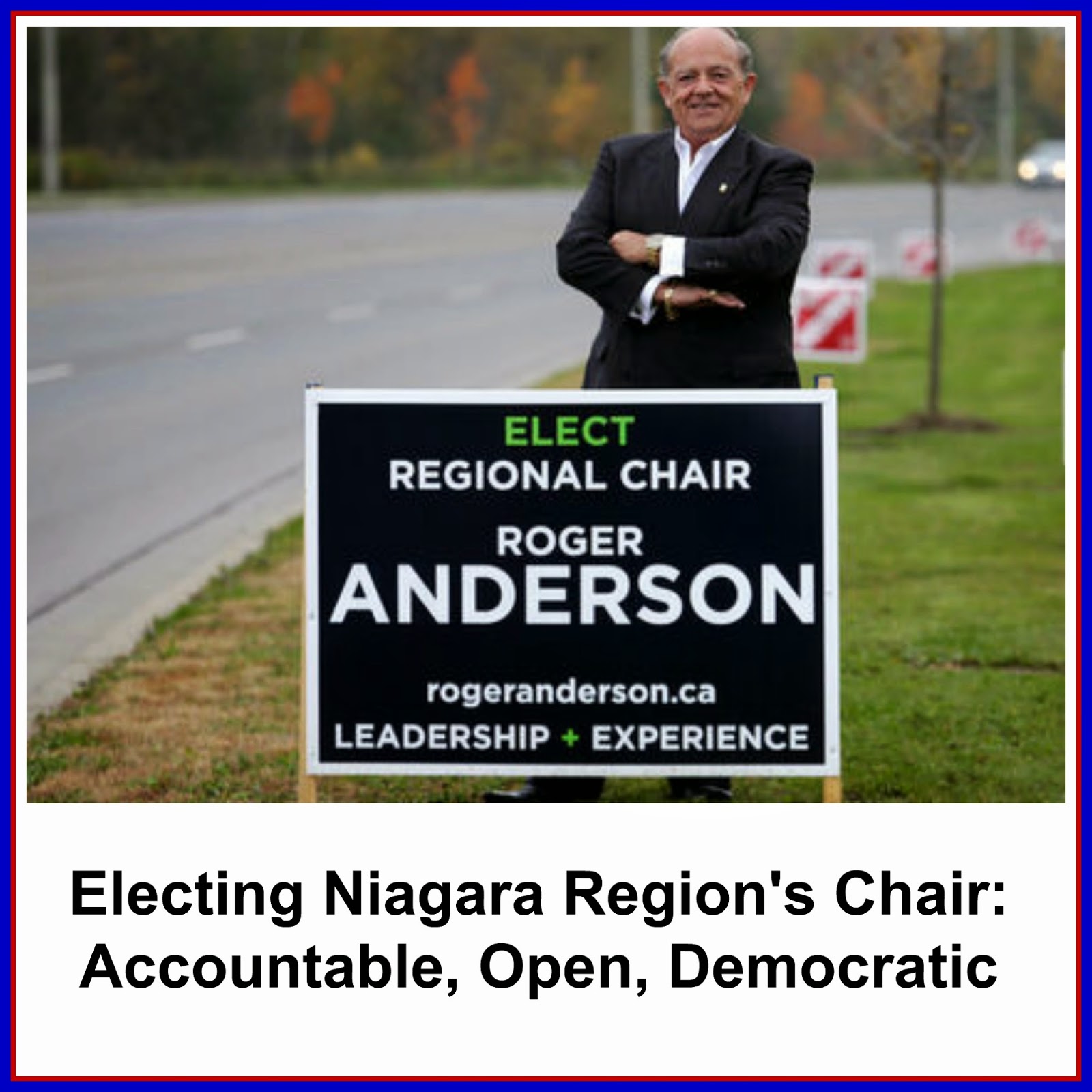
Electing Niagara Regional Chair to Become More Accountable, Open & Democratic

Roger Anderson was victorious as the first elected
chair of Durham Region, 2014.
Since the Regional Chair holds an extremely important leadership role in Niagara, and now that we have appointed a Chair, I believe it’s time to start the process now so that all Niagara residents can electe the Regional Chair “at large” in 2018.

Role of the Chair:
The full-time Regional Chair sets the legislative and economic agendas for the Region, presides over Council meetings, votes on every committee, and is the “face” of Niagara with Provincial, National, and other governments.

So, while serving as the face of the entire Niagara Region, ironically, the Regional Chair is only accountable to the majority of Regional Councillors.

Baldwin Act & County Councils:
Our current process of appointing a sitting member of Council as chair comes from the Baldwin Act of 1849, which established local County Councils. The names of the annually appointed, former Wardens of Welland County and Lincoln County are etched on two plaques at the Regional HQ (across from Brock University).

When they first created Regional Governments in the 1970s, the Province also appointed the first Regional Chairs. After our first Chair (John Campbell) retired in 1985, Council appointed one of its own as Chair (Wilber Dick).

But, this appointment differs significantly from County Councils days – the new Chair give up his or her seat and is appointed for the entire four-year term of Council.

Lagging Behind Other Regions:
All other Ontario Regional governments have already either adopted a more accountable and democratic process to directly elect their Regional Chair at large or are in the process of doing so.

Waterloo Region (Kitchener, Waterloo, Cambridge, Wilmot, Wellesley, Woolwich, and North Dumfries) began electing their Chair 17 years ago. Halton Region (Burlington, Oakville, Milton, and Halton Hills) has elected a Regional Chair since 2000. Durham Region (Pickering, Ajax, Uxbridge, Oshawa, Whitby, and Clarington) first elected their Regional Chair last Fall.

A bill to elect the York Region (Aurora, East Gwillimbury, Georgina, King, Markham, Newmarket, Richmond Hill, Vaughan, Whitchurch–Stouffville) Chair “at large” is currently before the Ontario Legislature. Finally, in 2013, Peel Regional Council (Brampton, Mississauga, and Caledon) directed staff to report in 2015 on options to directly elect their Chair for 2018.

It’s Time for Niagara:
It’s clear that the way in which Niagara Region currently appoints our Regional Chair is antiquated, undemocratic, and out-of-synch with all other Regions in Ontario.

That’s why I am making a motion at Regional Council on Thursday to begin the process to change toward a directly elected Chair. If you agree, please contact your Regional Councillor.

Let's work together now to become more open, transparent, accountable, and democratic in Niagara!

Monday, August 25, 2014

Promoting Pelham’s Interests at AMO Conference

Last week, Councillors King and Papp, Town CAO Darren Ottaway, and I attended the 115th Annual Association of Municipalities of Ontario Conference (AMO). The Annual Conference offers a range of learning sessions and networking opportunities for municipal leaders. More than 1,200 delegates attended the three-day event in London themed “At the 4front.”

While at AMO, your Pelham reps also directly advanced your interests with the Provincial Government through meetings with various Ministries.

First, we met with the Lou Rinaldi, MPP & Parliamentary Assistant to the Minister of Municipal Affairs & Housing, to propose changes to the Greenbelt Plan and to the Ontario Municipal Board (OMB). We asked that the commercial district of Ridgeville be included as a “hamlet” during the 2015 review of the Greenbelt; we also suggested that the Government relax the rules to make it easier for Towns to build Fire Stations in the Greenbelt and that they consider more flexibility for farm operations. Then we suggested improvements to the OMB appeal process based on the months and months of delays we faced before the ultimate approval of the Town’s Official Plan and East Fonthill Secondary Plan.

Next, we met with Arthur Potts, MPP & Parliamentary Assistant to the Minister of Agriculture & Rural Affairs regarding a potential multi-faceted community centre. We outlined the extensive process we have used to determine the need for and feasibility of a centre; we also explained our need for Provincial funding to help make the construction more affordable. Finally, we outlined the other important developments in the East Fonthill area – the medical centre, the retirement home, the home for Wellspring Niagara, and the additional retail businesses.

Then, we met with Kathryn McGarry, MPP & Parliamentary Assistant to Minister of Transportation, regarding the proposed streetscape cross-sections – including separate bike and walking paths – and the construction of a public square in the East Fonthill development. We also asked to work together with MTO to increase the “way-finding” signage to Pelham.

We met also with Eleanor McMahon, MPP & Parliamentary Assistant to Minister of Natural Resources and expressed our deep appreciation for the recent protection of the Fonthill Kame as an Area of Natural & Scientific Interest (ANSI). The Ministry protected the Kame after our five years urging and we requested that protections remain untouched for many decades.

Finally, I also joined other Niagara Mayors and the Regional Chair to meet with the Honourable Steven Del Duca, Minister of Transportation, to express the rational for an extension of GO transit commuter rail service to Niagara Region.

Please be assured that Council and I will continue to take all opportunities to promote Pelham’s interests to the Provincial Government.

Monday, June 30, 2014

Happy Canada Day in Pelham!

As we take this opportunity to gather and to proudly celebrate all it means to be Canadian, let’s also celebrate all the wonderful features about our Town!

From breathtaking vistas, to babbling brooks, to plentiful orchards and rich agricultural soil, Pelham enjoys a refreshingly natural and rural character. This natural character especially stands out during the spring and summer.

From the historic settlements of Effingham, Fenwick, Fonthill, Ridgeville, and North Pelham, the Town of Pelham remains grounded with a distinctive, small-town feel.

Home to diverse and creative businesses, Pelham also offers unique goods and services to residents and visitors. Their continued success depends on our patronage.

You and I are also blessed to have so many of our neighbours working to make our Town a prosperous, vibrant and caring community. I continue to marvel at the work and dedication of so many generous volunteers who form the foundation of our vibrant community. From the Fenwick Lions Carnival, to the weekly Farmer’s Market, to the Fonthill Bandshell Concert Series, to Pelham Summerfest, to the Canada Day Parade, volunteers organize and run our Town’s significant public events.  From Communities in Bloom, to the Horticultural Society, to those that have “adopted a road”, volunteers work to beautify our Town. In every sport from baseball and hockey, to soccer and tennis, volunteers – like the coaches, convenors, and score keepers – ensure that our children enjoy the fun-of-the-game.

We also live in a peaceful, safe community with great schools, and many recreation opportunities. We enjoy clean water, wonderful libraries, and a great mix of fully-accessible neighbourhood and community parks.

A dedicated police service, devoted volunteer firefighters, and expert emergency personnel protect you and I from harm. We have fair access to good and affordable healthcare.

We enjoy freedoms of conscience and religion, of thought, belief, opinion and expression, of assembly, and of association. We are free from persecution and from tyranny.

And, while we may have some work in a few of these areas, when compared on a global scale, we fare very well and should be very thankful.

Council and I are committed to working together with you to preserve our Town’s unique urban and rural blend and to ensuring that Pelham maintains our distinctive, small-town feel as we grow. We are also committed to Pelham becoming the most vibrant, creative, and caring community in all of Niagara.

As you and your family and friends commemorate our country’s 147th Birthday, I hope you will join me in celebrating and in giving thanks for our Pelham and our Canada.

Monday, December 9, 2013

Budgets Mean More Improvements in 2014

Since Town Council approved our 2014 Capital Budget last week and Regional Council is set to approve our 2014 Operating, Capital, and Rate budgets this week, I wanted to inform you about some major improvements planned for Pelham next year.

“Uptown Fonthill” Reconstruction:
Regional Council’s 2014 Capital Budget includes $4.0 million (including nearly $1 million from the Town) to reconstruct Regional Road 20 from Peachtree Park to Lookout Street, and to reconstruct Haist Street from Canboro Road to RR20. The works will include adding bikelanes, adding new sidewalks, upgrading the watermain, road reconstruction (including a turning lane to Haist Street North), and a new traffic signal. Regional staff hopes to begin work in early-spring and be done in early-September. Because of significant developments between Haist and Lookout on Hwy 20, I refer to this area as “Uptown Fonthill.”

Downtown Fenwick Revitalization:
While Council budgeted funds to revitalize Downtown Fenwick in 2013, staff ran into delays with design, with added work (storm sewer to Church Street) and with utilities. In 2014 we budgeted $4.0 million to reconstruct the roads, bury the hydro lines, and make the Downtown more pedestrian friendly. The consulting engineers will meet with the public on December 19 to review the final design with the hope that work can begin in early-spring. Council directed staff to ensure as little negative impact on Downtown businesses as possible.

Peace Park:
Council earmarked funds to landscape and improve Peace Park so that the overwhelming success of the Fonthill Bandshell, the Farmer's Market, and Summerfest can grow. The plan includes tiered seating (for lawn chairs) around the Bandshell, fully-accessible internal pathways, enhancing the cenotaph, and opening-up the park for more multi-use activities. Council directed staff to ensure these improvements do not interfere with the June start of the Bandshell.

East Fonthill & Port Robinson Road:
As you know, the Town has been planning for growth and development in the East Fonthill area for several years. This area includes +450 acres from Regional Road 20 and south along Rice Road, past Merritt Road. The area could accommodate 5,000 people over the next 20-25 years and includes significant commercial / mixed use lands along Hwy 20. Council insists on a great development that is walkable, cyclable, fully integrated to Downtown Fonthill and existing neighbourhoods, and adds to our small-town feel. The Town will reconstruct Port Robinson Road from Station Street to Rice Road next summer and will begin constructing services and internal roads in late-summer / early-fall.

I look forward to working together with you on these and many other improvements in 2014.

Monday, November 11, 2013

Should We Appoint or Hold A By-Election?

As you know, Larry Clark resigned from Town Council effective November 5 because he and his family will be moving back to British Columbia in February. He served as Councillor since 2010 and will be missed for offering a common-sense approach while representing Ward One residents. Council accepted his resignation “with regret” on November 4.

During our November 18 Council meeting, we will officially declare the seat “vacant.” Later that evening, during our Committee meeting, Councillors will discuss a report outlining the options to fill the seat.

Vacancies like this have occurred three times in Pelham’s history. The first was in 1972 when a Councillor died while in office. Since the vacancy occurred within 90 days before the next election, Council followed the Municipal Act and did not fill the vacancy.

The second time was in 2008, when Malcolm Allen was elected to the House of Commons. With two-years remaining in the term, Council appointed the candidate who placed third in Ward One in the 2006 Municipal Election – James Lane.

The third time was in 2011 after Debbie Urbanowicz resigned for personal and health reasons three-months into our current, four-year term. At first, a majority of Councillors voted to call for applicants and vet them behind closed doors. However, because of the strong, negative community reaction, Council agreed to hold a by-election. That’s how Councillor Rybiak was elected in June 2011.

Essentially, the Municipal Act provides two options to fill a Council vacancy:

First, Council may hold a by-election. Eligible candidates must be Canadian citizens who are at least 18 years old and reside in the Town. (In March 2011, Staff estimated the cost for a by-election at approximately $8,000.)

Second, Council may appoint an “eligible” person within 60 days of declaring a seat vacant. An eligible person consents to the appointment and meets the above criteria for election.

Some Councils simply appoint the candidate who came next in the previous election; in this case, following his 2008 appointment, James Lane came third in the 2010 general election and second in the 2011 by-election.

Other Councils call for applicants and interview candidates in full, public view; the voting also occurs in full, public view. The City of Toronto used this process in October when they appointed Peter Leon to replace Doug Holyday (who was elected to the Ontario Legislature in August).

Before our discussion next Monday, I am very interested in hearing your views; please call me or email me at mayordave@pelham.ca. You may also want to speak to your Councillors directly; please click here for their contact info on the Town of Pelham website.

Monday, September 23, 2013

How should we spend your money in 2014?

Do you have a suggestion on how the Town should spend your money?

The question seems timely not because the final instalment for 2013 property taxes is due September 30, but, rather, because Council will start formally thinking about our 2014 budget in October.

Council will begin our 2014 budget process with a special public meeting where we listen to you about what you would like to see in future budgets. That meeting will occur on Tuesday, October 15 at 6:30 PM in the Council Chamber at Pelham Town Hall.

While Pelham Council first started this type of a “pre-budget consultation” for the 2007 Budgets, we continue each year to welcome residents and property tax payers to provide input.

I am pleased that, following Council deliberations each year, we have been able to follow-through on most of the suggestions offered by your friends and neighbours. In previous year, folks have requested a dog park, a skate park, sidewalks along a number of roads (like Pelham Street), crosswalks, and sidewalk snow clearing on every sidewalk in Town; each of these examples are either currently being done or have been approved and will get done soon.

That’s why we are undertaking this consultation process again. Council and I want to hear directly from you about your needs, wants, and ideas for our Town.  Our community improves when more and more people become involved in its success!

And, this is just the start of our 2014 budget deliberations:
• Pre-Budget Consultation – beginning October 15, 2013;
• Draft Capital Budget available to public – November 22;
• Draft Capital Budget presented to Committee – November 25;
• Council consider approving Capital Budget – December 2;
• Draft Operating Budget available to the public – January 24, 2014;
• Draft Operating Budget presented to Committee – January 27;
• Council consider approving Operating Budget – February 3;
• Draft Water & Sewer Budgets available to the public – February 14;
• Draft Water & Sewer Budgets presented to Committee – February 18;
• Council consider approving Water & Sewer Budgets – March 3.

Prefer to provide written input?  Simply send a letter via email to a special email address:  ourbudget@pelham.ca. You will also soon be able to view background budget information at the Town’s website: www.pelham.ca.

Not internet savvy?  You can also provide written comments via normal mail c/o Town Clerk, Town of Pelham, 20 Pelham Town Square, P.O. Box 400, Fonthill, ON   L0S 1E0.

I hope to hear from you and I look forward to discussing your ideas so that we can continue to build a better future for our Town together.

Monday, August 26, 2013

Making Pelham More Walkable & Cyclable This Fall

Some imminent construction will not only improve roads but will also make the Town even more walkable and cyclable.

Port Robinson Road:
The Town will reconstruct Port Robinson Road from Pelham Street to Station Street including repairing some sewer sections, and replacing water lines and storm-sewers this fall. The rebuilt road will include bike lanes and parallel parking along the School. Finally, we will reconstruct and add sidewalks on both sides of the road and re-align the Steve Bauer Trail entrance to match Station Street. (While the Town awarded the contract in June to try to complete this work prior to the restart of school, an MOE approval, the surprise location of a gas-line, and the contractor’s schedule added to the project’s timeline.)

Pelham Street:
You will recall that while Council earmarked $2.5 million for reconstructing Pelham Street from College Street to Quaker Road, the estimate came back at $6.5 million. We did apply for special Provincial funding in January (thanks to the Glynn A. Green School community, the PBA, the Chamber, and all others who wrote letters of support!), but learned we were unsuccessful in the spring. Perhaps we can apply under a new, $100 million Provincial program this fall.

In the meantime, the Town will construct a new sidewalk on the west-side of Pelham Street from Pancake Lane to Brock / Port Robinson Road this fall. 

What about the idea of a traffic signal at Pancake? Installing a complete traffic signal did not meet the Ministry of Transportation’s “warrants” but did meet some opposition from local residents. Following the successful use of the Creative Problem Solving Process, Council recently approved the installation of pedestrian-priority traffic signals (like that on Haist Street at A.K. Wigg School) at Pancake Lane / John Street and at Spruceside Crescent / Bacon Lane this fall. We will also paint reduced lane widths as an attempt to lower vehicle speeds and to provide more room for cyclists.

Regional Road #20:
The Region will be constructing a special storm-sewer outlet from Regional Road 20 through Marlene Stewart-Streit Park this fall. Town Council recently approved reallocating some savings from this project so that we can add sidewalks along both sides of “Old Hwy 20” from Park Lane to Pinecrest and from Canboro Road to Church Hill. The Region will also resurface the road in that area.

And, did you notice the new school-zone lights on Regional Road #20 around St. Alexander School? Please watch for their activation next week during student’s morning and afternoon walks to school.

Pelham Town Square and Church Hill:
The Town will also reconstruct the sidewalk on the south-side of Pelham Town Square from Station Street to the Post Office and install a pedestrian-priority traffic signal at Church Hill across Pelham Street this fall.

Please be assured that Council and I continue to strive in making Pelham even more walkable and cyclable.