Last week, Councillor Accursi, Councillor Papp, Town CAO Ottaway, and I attended the Association of Municipalities of Ontario (AMO) Conference in Ottawa. The annual three-day conference offered a range of learning sessions and networking opportunities for the more than 1,500 delegates.
While at AMO, your Pelham representatives also met with various Ministries to directly advanced your interests with the Provincial Government.
We met with Hon. Jeff Yurek, MPP, Minister of Natural Resources & Forestry (MNRF), and Toby Barrett, MPP, Parliamentary Assistant, about maintaining and increasing the protection of the Fonthill Kame. Over the last 10 years, we effectively used AMO and “Niagara Week” meetings to urge the Province to enhance the Area of Natural & Scientific Interest (ANSI) protections of the Kame. For the last few years we thanked the Provincial Government for finalizing those protections in late-2013. Now, we asked to work together with MRN Staff to add more of the Fonthill Kame to the protections offered by the Niagara Escarpment Plan.
We are delighted that Minister Yurek indicated that the Government would not be changing the ANSI protections! We look forward to working together on further safeguards.
We also met with Hon. Steve Clark, MPP, Minister of Municipal Affairs & Housing, about Provincial funding. We encouraged the government to fund municipal projects that help create wealth and prosperity for a community; we spoke not only about projects like downtown revitalizations but also community and cultural facilities like community centres and libraries. We also discouraged the government from investing in projects that create more sprawl – like urban boundary expansions or “smart centers” disconnected from community. Ministry Staff indicated that they could work with the Town on these issues.
The Minister also informed us about his planned review of Regional governments following this Fall’s municipal elections; we indicated that Niagara would definitely want to participate. This was consistent with his message earlier in the conference when he shared his focus in working with local governments: cut red tape, increase the housing supply, reduce unnecessary reporting, strengthen regional governments, and find efficiencies.
We also listened to the three party leaders. Premier Ford acknowledged that Cities and Towns are “closest to the people” and stated that the Government had no plans for Toronto-type election reform on other cities “in the near future.” The Premier ended his speech talking about his Government by stating: “A new day has dawned in Ontario.”
Obviously AMO also many includes educational sessions and panel discussions.
Because of Pelham Council’s ongoing work, I especially appreciated the panel about “campus-style” approaches for Long-Term Care and retirement homes. We can use some of these suggestions to further enhance Pelham’s plans for a new medical centre, new seniors affordable housing, new senior’s apartments, a retirement residence, and a long-term care facility in Fonthill. Scheduled to start over the next year, these new housing and service developments are planned around the new Community Centre, Wellspring Niagara’s new Regional Cancer Support Centre, and the new stores and restaurants.
I also attended an information session about “Cannabis and Communities” – where the Provincial representatives shared that one of the “first orders of business” for a Council will be to decide whether to “opt-out” of allowing recreational cannabis retail outlets in their City or Town.
Finally, I was pleased to attend a session by representatives of Petrolia, Sioux Lookout, and East Gwillimbury about ways in which they worked with neighbouring communities to combine services to residents and businesses or find efficiencies in those services. I am committed to helping these types of discussions among the cities and towns across the Niagara Peninsula.
Not only did the AMO Conference encourage your Pelham delegates to use “best practices” and reach higher goals, we also used it as a tremendous opportunity to advance your interests with Provincial Ministries and build relationships with other municipal leaders.
You may contact Mayor Dave at mayordave@pelham.ca and find documents and past columns at www.pelhammayordave.blogspot.ca.
Showing posts with label Mayor Dave. Show all posts
Monday, August 27, 2018
Monday, April 23, 2018
Pelham Water & Sewer Rates Lowest Again
I am delighted that Council is set to approve a water and waste water budget at our next meeting where Pelham’s charges will be the lowest across Niagara again. While we plan to increase the fixed component slightly, this change will mean an increase of $8.76 per year or 1.4% for the average residential home (that uses 25 cubic meters of water every two months).
How do Pelham’s water and waste water charges compare with others Cities and Towns in Niagara? And, how are we able to keep rates so low?
Best in Niagara Yet Again:
I reviewed the most up-to-date rates and calculated the fixed charges and the rates for both water and waste water for Pelham and for the other local municipalities. At $106 for two months (for the average residential use of 25 cubic metres) Pelham leads the pack again with the lowest combined water and waste water charges!
Two of our neighbouring municipalities – St. Catharines and Lincoln – are between 13% and 17% more expensive than the combined water and waste water charges for Pelham. Five others – Niagara Falls, Thorold, West Lincoln, Niagara on the Lake, and Welland – are 25% to 55% more expensive. Two – Port Colborne and Fort Erie – are 93% and 189% more expensive than Pelham. (The average charge is $360 more (or 57% more) per year than Pelham’s charges!)
RF Meters Continue to Pay Dividends:
You will recall that prior to 2010 the Town measured water usage and calculated waste water charges with old gallon and cubic meter odometer-type wheel meters – many from the 1960s, 1970s, and 1980s. Many of the aged-meters counted slowly or were failing/broken. It took two weeks to collect readings. If your water had a leak, it could take months to detect.
In 2010, the Town worked with Neptune Technology to replace and upgrade all 4,200 our meters to electronic, RF (Radio Frequency) meters. In addition to leak, backflow, and tamper detection, it only takes 3-4 hours for staff to collect usage data every two months.
Not only does this cost less and give much more accurate billing, but we also automatically notify residents / businesses by phone if there is a leak or other issue with their water service. And, after replacing all the meters, we reduced our water loss from more than 20% to less than 10%!
Infrastructure Upgrades:
As you know, we have also upgraded significant Town infrastructure over the last number of years. As we reconstructed or improved roads like Haist Street, Pelham Street, Canboro Road, and Hurricane, we also replaced old water and sewer pipes. Over the last number of years, we replaced more than 15 kilometers of cast iron water mains, which helped stop costly leaks and reduces the number of breaks and repairs.
Council and I are delighted that the Town’s investments in innovation and infrastructure save you hundreds of dollars each year and allow us to provide the least expensive water and sewer charges in Niagara yet again!
You may contact Mayor Dave at mayordave@pelham.ca or see comparison charts at www.pelhammayordave.blogspot.ca.
Labels:
Mayor Dave,
Mayor Dave Augustyn,
Pelham,
sewer,
Town of Pelham,
water
Monday, April 16, 2018
Pelham’s 2018 Blended Residential Taxes Up 1.9% -- 12 Year Increase Less Than Inflation
If you pay your property taxes by installments, you will know that the second installment of your 2018 property tax bill comes due in two weeks (April 30). With this deadline approaching, I wanted to tell you about Pelham’s 2018 blended residential property tax increase – at 1.9% – and also to compare with other Cities and Towns.
You will recall that the amount of property tax you pay to the Town of Pelham, to the Niagara Region, and to the Province (for Education) is not solely based on the Market Value Assessment of your property by the Municipal Property Assessment Corporation (MPAC); one must multiply your assessment by each of these three tax rates and add them up for your total bill.
With both the Region and the Province making some policy changes and adjustments for rates and tax ratios, we now know that the combined property tax increase for an average residential property (which is valued at $328,138) in Pelham will be 1.9% for 2018. That means an average residential tax bill of approximately $4,187 or an increase of about $79 over last year. (Because of some rates changes, that’s actually a bit lower than the 2% to 2.3% range that I reported to you in February.)
You can consider this $79 or 1.9% a “pocket-book” increase – an increase in the amount it cost an average residential property owner because it’s adjusted for the average MPAC increase in Pelham.
Since Pelham’s portion of your property taxes represents roughly 39% of the total bill, the Town will make use of about $1,618 of the $4,187 for the average residential property.
Who gets the most? The Niagara Region will get about $2,012 or 48% of the total amount. Meanwhile, the Province will receive the remaining approximately $558 (or 13%) to help fund education.
How do we measure whether the increase is “affordable” or not?
One independent way to judge whether Pelham’s taxes are “affordable” is to compare with inflation. For example, the Bank of Canada calculated that, over the last 12 years (February to February), inflation increased the value of goods and services by 22.7%.
Over the same period, Pelham’s combined taxes for the average residential property increased by 22.0% – a bit lower than inflation. Essentially, that means that the average home is paying the same level of taxes in 2018 that they did in 2006!
And, this 22.0% over 12 years includes so many improvements in our community – from renewed Downtowns in Fonthill and Fenwick, to new Fire Halls in Fenwick and North Pelham, from nine renewed playgrounds, to a new skatepark and a new dog park, from a renewed Maple Acre Library to a renovated Old Pelham Town Hall, from 15 km of new sidewalks and 5 km of new trails to the new Meridian Community Centre. And, the list of other infrastructure and services goes on and on.
Another way to judge would be to compare with other Niagara Cities, Towns, and Townships.
Last Fall, the Region published a corrected table of non-blended property tax increases from 2010 to 2017 for local municipalities. If you start at zero in 2010 and add up the cumulative increases, Niagara Municipalities increased their property taxes an average of 35% over those eight years.
Pelham stands as the forth lowest because ours increased 30% – including an increase in funding for the Community Centre in 2016. That’s 14% below the average increase of other Cities and Towns for the same period. Three other growing Towns – Grimsby, Niagara-on-the-Lake, and West Lincoln were lower than Pelham since 2010.
Pelham Council and I continue to work together with staff to ensure that changes in property taxes only minimally impact you and your neighbour while improving the level and quality of services in the Town.
Please check out historic charts or read past columns at www.pelhammayordave.blogspot.ca. Please contact Mayor Dave at mayordave@pelham.ca.
Monday, September 11, 2017
Pelham’s Parkland Over-Dedication
Despite assurances that Town Council, staff, and professional advisors followed all appropriate laws and policies when dealing with a parkland over-dedication in East Fonthill, persistent questions still exist in the community. My column this week, therefore, explains how and why this type of special transaction occurs.
The award-winning East Fonthill Secondary Plan calls for a community park near the intersection of Wellsping Way and Summersides Boulevard and along-side a watercourse. Since it didn’t own all of this land, the Town had to ultimately acquire some property.
To acquire the parkland, the Town followed the Planning Act and the Town’s Parkland Dedication Bylaw and used funds exclusively from Pelham’s Parkland Dedication Reserve. (The Town did not use property tax funds to acquire this park.)
The Planning Act provides options for how a municipal council can acquire parkland and/or “cash-in-lieu” of actual land in new developments.
When a developer proposes a residential subdivision or builds a house, the Planning Act allows a Town to take 5% of the land from the new subdivision for public parkland, or to take a cash percentage of the land value (instead of actual property).
In the case of a cash-in-lieu allocation in Pelham, the Town requires a payment of 5% of the value of a serviced building lot at the “day before the of issuance of the building permit.” To determine this value, a developer or builder provides the Town with an accredited real estate appraisal for the land or for the subdivision.
As time goes on and other homes or businesses are built nearby, the property values increase and, therefore, the parkland payments increase.
Towns must deposit these cash-in-lieu-of-parkland funds into a segregated fund called the Parkland Dedication Reserve.
Sometimes, an overall community plan calls for a park that is larger than an individual property owner is legally obligated to provide – larger than 5% of the land the developer owns or plans to develop. In that case, the owner must give a “parkland over-dedication.”
A parkland over-dedication must be valued in the same way as a cash-in-lieu-of-parkland payment. In Pelham, therefore, an accredited real estate appraiser must value the over-dedication at the “day before the of issuance of the building permit.” Then, the Town uses funds from the Parkland Dedication Reserve to pay for the parkland. (Again, no property taxes are used for this purchase.)
Just as the value of building lots increase over time and as development occurs, the valuation for excess parkland also increases as nearby development occurs; it makes sense and costs less, therefore, to value and purchase parkland early and before the construction of nearby homes or businesses.
In the case of the 3.3 acres of East Fonthill parkland, the Town peer reviewed a 2015 accredited real estate appraisal and negotiated a parkland over-dedication value of $3.6 million. Since the local real estate market increased by as much as 20% since the time of the appraisal, the Town saved parkland funds by negotiating this transaction two years ago and before recent nearby construction.
The Town paid for this land from the Parkland Dedication Reserve. As new houses and businesses are constructed in the East Fonthill area and property values increase, builders and developers will have to contribute 5% of those increasing values to pay for this park and other parklands.
Negotiating the parkland over-dedication early and before rising property values, makes fiscal sense. And, getting re-payed for that parkland by builders as property values increase will provide value-for-money for the Town over the long run.
_________________________________
2017 September 15 Update:
The Town published some answers for frequently asked questions regarding parkland over-dedication and the development charge credits. Here's the text:
Q: Why did the Town purchase parkland in East Fonthill?
A: The award-winning East Fonthill Secondary Plan calls for a community park. Since it didn’t own this land, the Town purchased the parkland.
Q: Who determines the amount of land needed for parkland?
A: When a developer proposes a residential subdivision or builds a house, the Planning Act allows a Town to take 5% of land for the new subdivision for a park, or to take a percentage of cash instead of a property. In the case of a cash-in-lieu allocation in Pelham, the amount of payment is valued at 5% of the value of a serviced building lot at the ‘day before building permit’. For commercial or industrial property, the parkland is 2%. See section 51.1 in the Planning Act to read more: https://www.ontario.ca/laws/statute/90p13
Q: Who determined the value of the land?
A: The land was appraised and peer reviewed by a professional accredited appraisers to establish the value of the land.
Q: Wasn’t the appraisal value much higher than other land sold in the area?
A: The land was purchased at a price that reflected the value of the land at the ‘day before building permit’ stage. Land without roads, sidewalks, or additional development, for example, would not be valued the same as land that included all of those things, or at the ‘building-permit ready’ stage. When the Town purchases parkland land, it is done so using this formula, a system that is fair to both developers and the Town.
Q: What is this land going to cost me, the taxpayer?
A: Nothing. The land was purchased with funds in the Town’s Parkland Dedication Reserve. As new houses and business are constructed in the East Fonthill area, the property values will increase and builders and developers will have to contribute 5% of those increase values to pay for this and other parklands, replenishing the reserve fund. Towns must deposit these cash-in-lieu funds into that reserve fund.
Q: What is Parkland Over-Dedication?
A: Sometimes, an overall community plan calls for a park that is larger than an individual developer is legally obligated to provide – larger than 5% of the land the developer owns or plans to develop. In that case, the developer must give a parkland over-dedication.
Q: Was purchasing the land in 2015 a good idea or not?
A: Negotiating the parkland over-dedication early and before rising property values makes fiscal sense. Getting repaid for the parkland by builders as property values increase will provide value-for-money for the Town in the long run.
RE: OP-ED: Stop the dodging, I'll pay for the audit – The Voice of Pelham, September 13, 2017
Q: Did the Town do a secret deal with a developer, wherein the Town agreed to buy land from the developer, land the developer did not even yet own, in exchange for some $3 million dollars’ worth of “Development Charge credits,” and was this credits scheme even legal?
A: No, the Town did not do a secret deal with a developer. All agreements between the Town and any individuals or corporations are publicly approved. Specifically, on September 8, 2015, Town Council considered and approved the report “Over Parkland Dedication (East Fonthill) Agreement (Issue #20150901002)” and approved by by law 3650 (2015).
Q: Can parkland legally be purchased with Development Charges?
A: The Town did not purchase parkland using development charges. Parkland is purchased through the Parkland Dedication Reserve.
Q: Why did Town Council agree to pay $928,000 dollars per acre for this land when the going rate was approximately $150,000 to $200,000 per acre?
A: In the case of the 3.3 acres of East Fonthill parkland, the Town peer reviewed a 2015 accredited real estate appraisal and negotiated a parkland over-dedication value of $3.6 million. Since the local real estate market has increased by as much as 20% since the time of the appraisal, the Town saved parkland funds by negotiating this transaction two years ago and before recent, nearby construction.
For a printable version of these questions, please go to www.pelham.ca/ParklandFAQ.
You may contact Mayor Dave at mayordave@pelham.ca or read past columns at www.pelhammayordave.blogspot.ca.
The award-winning East Fonthill Secondary Plan calls for a community park near the intersection of Wellsping Way and Summersides Boulevard and along-side a watercourse. Since it didn’t own all of this land, the Town had to ultimately acquire some property.
![]() |
| Parkland in East Fonthill Plan |
The Planning Act provides options for how a municipal council can acquire parkland and/or “cash-in-lieu” of actual land in new developments.
When a developer proposes a residential subdivision or builds a house, the Planning Act allows a Town to take 5% of the land from the new subdivision for public parkland, or to take a cash percentage of the land value (instead of actual property).
In the case of a cash-in-lieu allocation in Pelham, the Town requires a payment of 5% of the value of a serviced building lot at the “day before the of issuance of the building permit.” To determine this value, a developer or builder provides the Town with an accredited real estate appraisal for the land or for the subdivision.
As time goes on and other homes or businesses are built nearby, the property values increase and, therefore, the parkland payments increase.
Towns must deposit these cash-in-lieu-of-parkland funds into a segregated fund called the Parkland Dedication Reserve.
Sometimes, an overall community plan calls for a park that is larger than an individual property owner is legally obligated to provide – larger than 5% of the land the developer owns or plans to develop. In that case, the owner must give a “parkland over-dedication.”
A parkland over-dedication must be valued in the same way as a cash-in-lieu-of-parkland payment. In Pelham, therefore, an accredited real estate appraiser must value the over-dedication at the “day before the of issuance of the building permit.” Then, the Town uses funds from the Parkland Dedication Reserve to pay for the parkland. (Again, no property taxes are used for this purchase.)
Just as the value of building lots increase over time and as development occurs, the valuation for excess parkland also increases as nearby development occurs; it makes sense and costs less, therefore, to value and purchase parkland early and before the construction of nearby homes or businesses.
In the case of the 3.3 acres of East Fonthill parkland, the Town peer reviewed a 2015 accredited real estate appraisal and negotiated a parkland over-dedication value of $3.6 million. Since the local real estate market increased by as much as 20% since the time of the appraisal, the Town saved parkland funds by negotiating this transaction two years ago and before recent nearby construction.
The Town paid for this land from the Parkland Dedication Reserve. As new houses and businesses are constructed in the East Fonthill area and property values increase, builders and developers will have to contribute 5% of those increasing values to pay for this park and other parklands.
Negotiating the parkland over-dedication early and before rising property values, makes fiscal sense. And, getting re-payed for that parkland by builders as property values increase will provide value-for-money for the Town over the long run.
_________________________________
2017 September 15 Update:
The Town published some answers for frequently asked questions regarding parkland over-dedication and the development charge credits. Here's the text:
Q: Why did the Town purchase parkland in East Fonthill?
A: The award-winning East Fonthill Secondary Plan calls for a community park. Since it didn’t own this land, the Town purchased the parkland.
Q: Who determines the amount of land needed for parkland?
A: When a developer proposes a residential subdivision or builds a house, the Planning Act allows a Town to take 5% of land for the new subdivision for a park, or to take a percentage of cash instead of a property. In the case of a cash-in-lieu allocation in Pelham, the amount of payment is valued at 5% of the value of a serviced building lot at the ‘day before building permit’. For commercial or industrial property, the parkland is 2%. See section 51.1 in the Planning Act to read more: https://www.ontario.ca/laws/statute/90p13
Q: Who determined the value of the land?
A: The land was appraised and peer reviewed by a professional accredited appraisers to establish the value of the land.
Q: Wasn’t the appraisal value much higher than other land sold in the area?
A: The land was purchased at a price that reflected the value of the land at the ‘day before building permit’ stage. Land without roads, sidewalks, or additional development, for example, would not be valued the same as land that included all of those things, or at the ‘building-permit ready’ stage. When the Town purchases parkland land, it is done so using this formula, a system that is fair to both developers and the Town.
Q: What is this land going to cost me, the taxpayer?
A: Nothing. The land was purchased with funds in the Town’s Parkland Dedication Reserve. As new houses and business are constructed in the East Fonthill area, the property values will increase and builders and developers will have to contribute 5% of those increase values to pay for this and other parklands, replenishing the reserve fund. Towns must deposit these cash-in-lieu funds into that reserve fund.
Q: What is Parkland Over-Dedication?
A: Sometimes, an overall community plan calls for a park that is larger than an individual developer is legally obligated to provide – larger than 5% of the land the developer owns or plans to develop. In that case, the developer must give a parkland over-dedication.
Q: Was purchasing the land in 2015 a good idea or not?
A: Negotiating the parkland over-dedication early and before rising property values makes fiscal sense. Getting repaid for the parkland by builders as property values increase will provide value-for-money for the Town in the long run.
RE: OP-ED: Stop the dodging, I'll pay for the audit – The Voice of Pelham, September 13, 2017
Q: Did the Town do a secret deal with a developer, wherein the Town agreed to buy land from the developer, land the developer did not even yet own, in exchange for some $3 million dollars’ worth of “Development Charge credits,” and was this credits scheme even legal?
A: No, the Town did not do a secret deal with a developer. All agreements between the Town and any individuals or corporations are publicly approved. Specifically, on September 8, 2015, Town Council considered and approved the report “Over Parkland Dedication (East Fonthill) Agreement (Issue #20150901002)” and approved by by law 3650 (2015).
Q: Can parkland legally be purchased with Development Charges?
A: The Town did not purchase parkland using development charges. Parkland is purchased through the Parkland Dedication Reserve.
Q: Why did Town Council agree to pay $928,000 dollars per acre for this land when the going rate was approximately $150,000 to $200,000 per acre?
A: In the case of the 3.3 acres of East Fonthill parkland, the Town peer reviewed a 2015 accredited real estate appraisal and negotiated a parkland over-dedication value of $3.6 million. Since the local real estate market has increased by as much as 20% since the time of the appraisal, the Town saved parkland funds by negotiating this transaction two years ago and before recent, nearby construction.
For a printable version of these questions, please go to www.pelham.ca/ParklandFAQ.
You may contact Mayor Dave at mayordave@pelham.ca or read past columns at www.pelhammayordave.blogspot.ca.
Labels:
East Fonthill,
Mayor Dave,
Mayor Dave Augustyn,
Parkland,
Pelham,
Town of Pelham
Sunday, January 22, 2017
"Dual Duty": A Less Democratic, Out-of-Date Approach
Do you think we should elect more full-time politicians in Niagara?
Should it be harder for people to represent the views of their neighbours? Or, should anyone be able to serve part-time on local Council and offer their experiences from a job or other activities?
People are asking these thoughtful questions about the "dual duty, ward Councillor" proposal for the City of St. Catharines and Niagara Regional Councils.
Currently, St. Catharines elects 12 part-time (PT) City Councillors (two in each of six wards), and six part-time Regional Councillors ("at-large" across the City). City residents also elect a full-time (FT) Mayor who serves on both Councils. That’s 19 people (12 PT + 6 PT +1 FT = 18 PT & 1 FT) representing citizens on the two Councils.
The change would see St. Catharines represented by 13 people: the Mayor and six full-time politicians would serve on both City and Regional Councils; the other six part-time Councillors would serve only on City Council (6 FT + 6 PT + 1 FT = 6 PT & 7 FT).
Proponents suggest that by reducing the number of local representatives "communication, cooperation, and accountability" would increase between the City and Region.
Opponents suggest that the change will create six more full-time politicians (who would want "full-time wages"), attract partisans, and make local government less accountable and more out-of-touch from average citizens. Others believe it would give more control to fewer people (like at the NPCA where 11 of the 12 Niagara reps were appointed by the same Regional Council on which they serve).
Interestingly, the majority from across Niagara – more than 58% according to a survey last Fall – do not want the change.
And while proponents say that the dual duty "modernizes" communication and coordination of local government, we know that other Regions made similar changes more than 25 years ago. That was before AOL email (21 years old), Google (18 years), and web browsers like Netscape (21 years). That was also before the widespread use of cell/smartphones and cheap long-distance calling. At that time, everything was paper-based and getting a fax felt like a novelty.
Now, we live stream and archive Committee and Council meetings, pre-publish complete electronic agenda packages, and use smartphones, cellular iPads, texts, social media, pictures, videos, and emails to communicate instantly with colleagues, staff, and citizens.
Further changes over the last decade include routine meetings between Regional and City / Town chief administrative officers, planners, economic development officers, treasurers, engineers, transit managers, clerks, and Mayors. In some Towns – like Pelham and Fort Erie – the Regional Councillor presents written updates to local Council and answers questions every three weeks.
Because we solved these communication and coordination issues long ago, and because it will concentrate power into the hands of fewer people and increase the number of full-time politicians, I voted against the dual duty proposal last Thursday at Regional Council.
Since it was approved by a 17 to 11 vote, each local Council will also consider the proposal; please let your City, Town or Township Councillor know your thoughts.
![]() |
| Current: 18 part-time Councillors, 1 full-time Mayor |
People are asking these thoughtful questions about the "dual duty, ward Councillor" proposal for the City of St. Catharines and Niagara Regional Councils.
Currently, St. Catharines elects 12 part-time (PT) City Councillors (two in each of six wards), and six part-time Regional Councillors ("at-large" across the City). City residents also elect a full-time (FT) Mayor who serves on both Councils. That’s 19 people (12 PT + 6 PT +1 FT = 18 PT & 1 FT) representing citizens on the two Councils.
The change would see St. Catharines represented by 13 people: the Mayor and six full-time politicians would serve on both City and Regional Councils; the other six part-time Councillors would serve only on City Council (6 FT + 6 PT + 1 FT = 6 PT & 7 FT).
Proponents suggest that by reducing the number of local representatives "communication, cooperation, and accountability" would increase between the City and Region.
Opponents suggest that the change will create six more full-time politicians (who would want "full-time wages"), attract partisans, and make local government less accountable and more out-of-touch from average citizens. Others believe it would give more control to fewer people (like at the NPCA where 11 of the 12 Niagara reps were appointed by the same Regional Council on which they serve).
![]() |
| Proposed: 6 full-time dual duty Councillors, 6 part-time Councillors, 1 full-time Mayor |
And while proponents say that the dual duty "modernizes" communication and coordination of local government, we know that other Regions made similar changes more than 25 years ago. That was before AOL email (21 years old), Google (18 years), and web browsers like Netscape (21 years). That was also before the widespread use of cell/smartphones and cheap long-distance calling. At that time, everything was paper-based and getting a fax felt like a novelty.
Now, we live stream and archive Committee and Council meetings, pre-publish complete electronic agenda packages, and use smartphones, cellular iPads, texts, social media, pictures, videos, and emails to communicate instantly with colleagues, staff, and citizens.
Further changes over the last decade include routine meetings between Regional and City / Town chief administrative officers, planners, economic development officers, treasurers, engineers, transit managers, clerks, and Mayors. In some Towns – like Pelham and Fort Erie – the Regional Councillor presents written updates to local Council and answers questions every three weeks.
Because we solved these communication and coordination issues long ago, and because it will concentrate power into the hands of fewer people and increase the number of full-time politicians, I voted against the dual duty proposal last Thursday at Regional Council.
Since it was approved by a 17 to 11 vote, each local Council will also consider the proposal; please let your City, Town or Township Councillor know your thoughts.
Labels:
Democracy,
Dual Duty,
Fort Erie,
Mayor Dave,
Mayor Dave Augustyn,
Niagara Region,
Pelham
Sunday, November 13, 2016
From “Sprawl” to a “Complete Community”
I keep the “Sprawl Repair Manual” by Galina Tachieva on my desk at home. The work “presents a comprehensive methodology for transforming sprawl” along with “implementation techniques” for “rebalancing suburbia.”
Why? Well, I hate to point out that much of Pelham developed as sprawl.
During the late-1800s and early-1900s, development in the former Township of Pelham and Village of Fonthill grew along traditional coach routes (like Canboro Road) and at crossings along the TH&B (through Fenwick) and NS&T (through Fonthill) railway lines.
But, the advent of the automobile quickly changed all that.
For example, only in a car-centered-culture would one build a high school on some of the best tender fruit land and on a (then) Provincial Highway.
Similarly, prior to the hundreds of homes around it, the Pelham Arena was erected in the mid-1970s in a farmer’s field and far from restaurants and retail.
In fact, much of Pelham’s previous residential development sprawled across farm lands and forests. These now-mature residential neighbourhoods from the 1970s and 80s contain more than 50 cul-de-sacs or courts! That’s quite different than traditional neighbourhoods of College, Emmett, Elm, Burton and Chestnut streets.
Previous Councils also expanded the Town’s “urban boundaries” – the areas in which one can develop. The +500 acres in East Fonthill and “Lookout Ridge” were added in 2000. Significant developable lands in Fenwick – from Cream to Balfour and between Memorial and Welland Road – were added in 1990.
Once approved, these urban-land-rights last forever, guaranteeing a development future for Pelham.
Given this history, how does one “repair” the sprawl and foster a more “complete” community?
We started by revitalizing Downtown Fonthill and Fenwick; in addition to rebuilding the streetscapes, one-third of the buildings on Pelham Street have recently improved their façades and added residential units.
We’ve also encouraged walking and cycling by building more than 13 km of sidewalks, 9 km of bike lanes, 7 km of trails, and 5 crosswalks. Now – 53 years after it opened – we’ve approved extending a sidewalk to Crossley. We’ve also discouraged car use by initiating Pelham transit.
We approved plans for East Fonthill that include wide-sidewalks and trails and a road network that links to existing streets; to enable these plans, we’ve even removed houses were future streets will go.
We’ve insisted on street-facing commercial development and on as pedestrian-friendly-as-possible parking. We continue to call for rear-lanes and we protected key environmental features.
Instead of consolidating services into a central building, we’re revitalizing the Maple Acre Library. And, we’re constructing the new Pelham Community Centre near other amenities – like stores and restaurants, and a future medical centre, retirement home, and other “mixed-uses.”
Finally, we remain committed to the Town’s urban boundaries and increased the protections on the Fonthill Kame.
Correcting Pelham’s sprawl isn’t easy, but Council and I will persevere toward that goal.
Why? Well, I hate to point out that much of Pelham developed as sprawl.
During the late-1800s and early-1900s, development in the former Township of Pelham and Village of Fonthill grew along traditional coach routes (like Canboro Road) and at crossings along the TH&B (through Fenwick) and NS&T (through Fonthill) railway lines.
But, the advent of the automobile quickly changed all that.
For example, only in a car-centered-culture would one build a high school on some of the best tender fruit land and on a (then) Provincial Highway.
Similarly, prior to the hundreds of homes around it, the Pelham Arena was erected in the mid-1970s in a farmer’s field and far from restaurants and retail.
In fact, much of Pelham’s previous residential development sprawled across farm lands and forests. These now-mature residential neighbourhoods from the 1970s and 80s contain more than 50 cul-de-sacs or courts! That’s quite different than traditional neighbourhoods of College, Emmett, Elm, Burton and Chestnut streets.
Once approved, these urban-land-rights last forever, guaranteeing a development future for Pelham.
Given this history, how does one “repair” the sprawl and foster a more “complete” community?
We started by revitalizing Downtown Fonthill and Fenwick; in addition to rebuilding the streetscapes, one-third of the buildings on Pelham Street have recently improved their façades and added residential units.
We’ve also encouraged walking and cycling by building more than 13 km of sidewalks, 9 km of bike lanes, 7 km of trails, and 5 crosswalks. Now – 53 years after it opened – we’ve approved extending a sidewalk to Crossley. We’ve also discouraged car use by initiating Pelham transit.
We approved plans for East Fonthill that include wide-sidewalks and trails and a road network that links to existing streets; to enable these plans, we’ve even removed houses were future streets will go.
We’ve insisted on street-facing commercial development and on as pedestrian-friendly-as-possible parking. We continue to call for rear-lanes and we protected key environmental features.
Instead of consolidating services into a central building, we’re revitalizing the Maple Acre Library. And, we’re constructing the new Pelham Community Centre near other amenities – like stores and restaurants, and a future medical centre, retirement home, and other “mixed-uses.”
Finally, we remain committed to the Town’s urban boundaries and increased the protections on the Fonthill Kame.
Correcting Pelham’s sprawl isn’t easy, but Council and I will persevere toward that goal.
Sunday, September 11, 2016
Unveiling & Rededicating WWI Cenotaph & Mortar
![]() |
| Royal Canadian Mounted Police Cst. Susan Phillips, WWII Veteran Jim Summersides, Pelham Mayor Dave Augustyn and Niagara Centre MP Vance Badawey. Photo Credit: Laura Barton/Welland Tribune |
Because of the generous partnership of the Town with the Canadian Government, the Royal Canadian Legion, and caring citizens, these newly restored artifacts now stand as a constant reminder of the ultimate sacrifices paid by Pelham residents and other Canadian soldiers in World War I to secure our freedoms.
The beautifully restored cenotaph was completed last year, in time for our 2015 Remembrance Day commemoration. May the names of those 18 local soldiers killed in battle for our freedoms also be engraved in our minds and on our hearts.
The WWI German Trench Mortar (called a minenwerfer) was captured by the 31st Battalion, Alberta Regiment, Canadian Expeditionary Force, in a raid on enemy trenches at Neuville Vitasse, France, on 23-24 of June 1918.
The mortar, considered a “War Trophy,” was awarded to the former Township of Pelham in 1921 by the Government of Canada. It was placed next to the Cenotaph in Ridgeville as a memorial to those from this area and the 31st Battalion, who made the ultimate sacrifice during the Great War 1914-18.
Historic research showed that Government provided this mortar with the understanding that it “belongs to the Crown and to the people of Canada…and was to be preserved and respected.”
Research also shows that this mortar is very rare. It was one of 101 trench mortars brought to Canada and is one of very few not melted down for the World War II war effort.
![]() |
| Photo Credit: Laura Barton/Welland Tribune |
Thankfully, a group of dedicated citizens and representatives came together to work with the Town and Council to help recommend what to do. Among others, these included Carolyn Botari, Dell Clark, Gary Chambers, Jake Dilts, Leo Giovenazzo, Mary Lamb, Bernie Law, and Jim Summersides.
Council and I deeply appreciate the work of these caring citizens, of Town Staff, the Royal Canadian Legion, Veterans Affairs, the Canadian Government, and the conservation company to fully restore and tell the story of this mortar for generations to come.
Further, we hope that these newly restored artifacts – outside our recently revitalized Old Pelham Town Hall – stand as a constant reminder of the ultimate sacrifices paid by Canadian soldiers in World War I to secure our freedoms.
______________________________________________________
Thanks to the hundreds who participated in and attended the special ceremony, including:
- Veterans & Members of Canadian Armed Forces;
- Members of the Royal Canadian Legion & Ladies Auxiliary, Branch 613;
- Members of the Burl-Oak Naval Veterans;
- Members of the Royal Canadian Mounted Police;
- Branch 613 Army Cadets;
- 87 Eagle Squadron Royal Canadian Air Cadets;

Photo Credit: Laura Barton/Welland Tribune - Grimsby Pipe Band;
- Reverend Myers;
- Mr. Allison, MP Niagara-West;
- Mr. Badawey, MP Niagara-Centre;
- Regional Councillors Baty & Quirk;
- Town of Pelham Councillors & Staff;
- Members of the Citizen Advisory Committee;
- David Hulley, Emcee.
Special thanks to Jim Summersides, World War II Hero, for assisting with the unveiling of the newly restored mortar and plaque.
Sunday, August 14, 2016
Kame, Ridgeville, Funding and Transit at AMO Conference
This week, Councillors Accursi and Durley, Town CAO Ottaway, and I will attend the Association of Municipalities of Ontario (AMO) Conference in Windsor. The annual three-day conference offers a range of learning sessions and networking opportunities and organizers expect more than 1,300 delegates.
While at AMO, your Pelham representatives will also directly advance your interests with the Provincial Government through meetings with various Ministries.
First, we will meet with Kathryn McGarry, Minister of Natural Resources (MNR), about increasing the protection of the Fonthill Kame. For the last eight years, we effectively used AMO and “Niagara Week” meetings to urge the Province to enhance the Area of Natural & Scientific Interest (ANSI) protections of the Kame. For the last couple of years we thanked the Provincial Government for finalizing those protections in late 2013. Like last year, we intend to ask MRN to add more of the Fonthill Kame to the protections offered by the Niagara Escarpment Plan.
Similarly, we will be meeting with the Bill Mauro, Minister of Municipal Affairs, about the same topic and more. You see, the Province is seeking final input on their "Co-ordinated Land Use Planning Review" -- a review of the Growth Plan for the Greater Golden Horseshoe, the Greenbelt Plan, the Oak Ridges Moraine Conservation Plan and the Niagara Escarpment Plan (NEP). These planning documents work together to "manage growth, build complete communities, curb sprawl and protect the natural environment." In addition to asking for adding additional Fonthill Kame lands under the protection of the NEP, we want to thank the Minister for fixing an historic planning error regarding Ridgeville. Since the Greenbelt Plan excluded the Hamlet of Ridgeville more than 10 years ago, the coordinated review is proposing that it be included and recognized.
Next, we will meet with Eleanor McMahon, Minister of Tourism, Culture & Sport, about the Pelham Community Centre and Provincial funding opportunities. Since Minister McMahon recently attended the launch of Pelham Summerfest, we will also be updating her about the successes of our signature, four-day festival.
Finally, we will meet with Daiene Vernile, MPP & Parliamentary Assistant to Minister of Transportation (MTO), regarding our Community Transportation Pilot Project. Thanks to $100,000 of Provincial funding, the Town has operated Pelham Transit for nearly a year as a pilot program. We will again thank the MTO for the grant, talk about plans for Regional Transit, and outline the need for ongoing sustainability of transit.
Please be assured that Council and I will continue to take all opportunities to promote Pelham’s interests to the Provincial Government.
Monday, July 18, 2016
Thanks for Best Summerfest Yet!
On behalf of Council and the community, thank you to the 2016 Summerfest Committee, Town Staff, service club and other volunteers for your hard-work and dedication and to the many generous sponsors who made this year’s four-day Summerfest the most successful yet!
First, I greatly appreciate the work of the Summerfest Committee, including John Wink, Chair; Councillor Gary Accursi; Bill Gibson, Active Transportation Committee rep; Candy Ashby, Pelham Business Association rep; Matthew Leask and Michelle Stewart, Pelham residents; and Sofia Labricciosa, Mayor’s Youth Advisory Council rep. The committee met for months prior to Summerfest to plan and finalize every detail and they worked very, very hard all weekend long to ensure a successful festival. Thank you very much!
Second, thanks so much to Town Staff! Thanks to Vickie van Ravenswaay, Sally Jaeger, Jodi Hendriks and other staff who helped organize the overall event and worked with the Committee to ensure success. I also appreciate the many Town staff who volunteered in one capacity or another – from setting up, to serving beverages, to cleaning up – throughout the four days; thanks for giving your time to our community. And, thanks to the (mainly) Public Works staff who worked during the Festival on logistics, garbage and recycling duty, and ensured the safety of participants and all the major clean-up!
Third, thanks to the very many members of the Town’s service clubs – including the Fonthill & District Kinsmen and Kinettes Clubs, the Fonthill Lions Club, and the Fonthill Rotary Club – for helping serve beverages and greeting patrons. We couldn’t have done it without you!
Fourth, thanks to the other members of the community who also volunteered! Thanks to members of the Pelham Fire Service, the Active Transportation Committee, the Pelham Seniors Advisory Committee, St. John’s Ambulance, the Mayor’s Youth Advisory Council, members of Town Council, and the many, many other community volunteers!
Fifth, thank you to the many Sponsors and Friends of Pelham Summerfest including our Gold Sponsors: Ball Construction, Fonthill Bandshell, Fonthill Dental, Halco Mobile, Lafarge Canada, McAvoy Belan & Campbell, Meridian Credit Union, RBC Royal Bank, and Square Roots Restoration. And, thanks to our amazing Media Partners including: Cogeco TV; Country 89; Erie Media; Giant FM; MyPelham.com; Niagara This Week; Pelham News; the Standard; the Tribune; and the Voice.
Finally, thanks to you and the more than 30,000 other people who enjoyed Pelham Summerfest over the festival’s four days! Your attendance and community spirit made it a huge success!
All of this work and participation – including the visit by Tourism Minister Eleanor McMahon, the amazing performances by Jully Black and the many other performers, the participation of Carlos and Suki from YTV, and the addition of a Sunday Car Show – helped make the 2016 Pelham Summerfest the best ever!
Sunday, April 17, 2016
Pelham’s 2016 Residential Taxes Increases by 2.4%
Two months ago I wrote about how Council approved our 2016 Operating Budget. Since the Province issued the property tax rate for Educational purposes last week, I can now provide you with an update on the total 2016 residential property tax bill.
You will recall that the amount of property tax you pay to the Town of Pelham, to the Region, and to the Province (for Education) is not solely based on the Market Value Assessment of your property; we multiply your assessment by each of these three tax rates and add them up for your total bill.
The Municipal Property Assessment Corporation (MPAC) – the Provincial body that sets a value your home and property – re-evaluated and assessed all properties in the Province as of January 1, 2012. While this amount will be used as the value of your home in 2016, MPAC phases in any assessment increases evenly over a four-year period. The Town uses that changing assessment value when we calculate your property taxes each year.
When Town Council approved our 2016 Operating Budget in February, we didn’t know neither the Regional nor the Provincial rates.
Now that the Region approved the property tax rates and ratios last month and that the Province set their rate last week, we know that the combined property tax increase for an average residential property (valued at $309,200) in Pelham will be 2.4%.
Please note that this 2.4% is the “pocket-book” increase – the amount it cost an average residential property owner by adjusting for the average MPAC increase.
(I am sure that you would be interested to know that approximately 1.1% of this 2.4% is attributable to the one-time increase for the Pelham Community Centre.)
How do we measure whether that amount is “affordable” or not?
One independent way to judge whether Pelham’s taxes are “affordable” or not, is to compare them with inflation. For example, the Bank of Canada calculates that, over the last 10 years, inflation increased the value of goods and services by 17.7%. Over the same period, Pelham’s combined taxes for the average residential property in Pelham increased by 17.4% -- slightly less than inflation. And, this includes the amount already included in the Town’s 2016 budget to help fund the Pelham Community Centre.
Pelham Council and I continue to direct staff to ensure that we only minimally impact you and other property tax-payers while we increase the level and quality of services to the Town.
Monday, March 28, 2016
An Elegant and Affordable Community Centre for Pelham
Last Tuesday, Council received several presentations about the Pelham Community Centre.
The Architects presented an elegant yet very efficient design that includes adaptable and multi-purpose community spaces, a double-gymnasium (dividable into four sections), a double arena (main arena with 1000 seats; second with less than 100 seats), an indoor walking/running track, a concession area, change rooms and washrooms, and an atrium / lobby area. (Please click here to see the Architect's slide presentation.)
Based on an item-by-item-review of the design and informed by their experience on more than 30 community facilities, Ball Construction estimated the construction costs at $32.5 million. The construction managers also pegged total project costs – including design, furniture, fixtures, permits – at $36.2 million. (Please click here to watch a video of Ball Construction's presentation.)
Staff stated that the Community Centre will cost $46.66 for an average residential property (assessed at $309,200) or 3.44% on the 2016 Pelham portion of the tax bill only. That amount will allow the Town to purchase a 30-year debenture of $9.07 million from Infrastructure Ontario. Since Council already approved project funds in our 2016 Budget, the Town will not require any further property tax increases to build the Centre beyond this year.
The Town will fund the remaining costs through development charges, East Fonthill land sales, and fundraising. (Please click here for Staff's slide presentation.)
All new housing units and construction pay Development Charges (DCs) to cover the costs for the facilities and infrastructure required to help serve their new developments. The Town’s DCs can fund $12.1 million for the Centre.
In 2005, the Town purchased the 32-acres at the corner of Rice Road and Hwy 20 for $3.6 million ($112,000 per acre). After re-designating, re-zoning, and fully-servicing those lands, the Town will be able to sell nearly 20 acres for an estimated $12 million ($600,000 per acre). (Including the $1.1 million in interest payments, this sale would represent a return on investment of +150%.)
Based on a number of one-on-one interviews, a professional fundraising feasibility study recommends that the community can raise at least $3 million for the Centre. The Town will acknowledge donor generosity through naming and various other types of donor recognition.
This conservative financial plan does not include revenue from other sources like assessment growth from new housing/developments or from upper levels of government. (Council and I will continue to work with local MPs and MPPs to attract government investments for this project and/or other infrastructure improvements.
You may review the designs and the financing plans for this very important and exciting project at www.pelham.ca/community-centre or at Town Hall or Library branches. And, you may speak to the Architect, Construction Manager, Town Staff, volunteer Architectural Design Advisory Committee members and Councillors at Open Houses on Saturday, April 16:
- Fire Station #2 (766 Welland Rd.) from 10:00 AM to Noon;
- Fire Station #1 (177 Hwy #20) from 2:00 to 4:00 PM
Thanks for your interest in this very important and exciting project for Pelham!
Monday, February 29, 2016
Provincial Budget Good News for Niagara & Pelham
![]() |
| Finance Minister Sousa presenting the 2016 Provincial Budget, February 25. |
First, in their Budget, released last Thursday, the Provincial Government committed to extending GO Rail service to Niagara. After submitting our formal business case last spring, all are thrilled to have this commitment in a significant Provincial document.
The budget states: "Subject to agreement with freight rail partners, two-way, all-day rail services on the. Kitchener and Milton GO corridors, and extension of GO rail service to Niagara and Bowmanville."
It’s as if the oft-repeated phrase of my colleague, Niagara Falls Mayor Jim Diodati, came true: “It’s not a question of ‘if’ GO rail comes to Niagara, it’s a question of ‘when’!”
And, while we don’t yet know when, Minister Jim Bradley, MPP St. Catharines and huge GO Rail Niagara advocate, explained last week that Transportation Minister Del Duca will provide more information before the end of June.
As we wait for that, we should keep in mind that it will take some time to get the Niagara GO business plan up-and-running. At best, the Province and Metrolinx could take some interim steps as early as next year; however, property acquisition, station construction, and track refurbishment for a run all-the-way to the Falls will take a couple of years. And, I wonder whether the opening of the Stoney Creek GO Station in 2019 will impact the plan for Niagara.
So, while we must keep pushing for GO Rail, I believe this announcement allows us now to concentrate on developing an integrated regional transit service. With our spring 2017 deadline approaching, I was pleased that the Region, in partnership with Welland, St. Catharines, and Niagara Falls, issued a request for proposals last week to help develop an integrated service.
Second, small municipalities like Pelham (with populations under 100,000) also heard great news in the Budget.
The Province announced it would triple – from $100 million to $300 million – the Ontario Community Infrastructure Fund (OCIF) by 2018-19. This fund will provide predictable funds for critical infrastructure projects. And, importantly for Pelham, we also heard that the Province will no longer penalize growing municipalities with good fiscal records. You will recall that Pelham lobbied the Province for this change since they denied us funding last year because of our community’s high property values and high-quality infrastructure compared to other Towns.
The Province also committed to match the Federal government’s $272 million commitment for the jointly administered “Small Community’s Fund” to “help address local priorities and support economic growth.”
On behalf of Council, I thank the Province for the commitment to Niagara GO Rail and support of small communities like Pelham.
Sunday, February 21, 2016
Pelham's 2016 Operating Budget Approved
Council recently approved the Town’s 2016 Operating Budget. The new budget translates into an increase of approximately 7.86% (or $107.44) on the Pelham portion of your property tax bill for the average residential property (assessed at $309,200).
Since Pelham’s portion of your property taxes represents roughly 37% of your overall residential tax, we anticipate the average “blended” increase – including the Regional and Provincial portions – to be around 2.9%.
In preparing for the operating budget, Council directed Staff to review all expenditures against customer service needs and the Town’s strategic plan.
The overall budget increased by $792,873 (net). The major increases over 2015 include:
• A $269,830 transfer to the capital reserves to help enhance and maintain our excellent infrastructure and build on the $175,979 that we added to capital reserves last year;
• $79,629 for increased maintenance and $49,731 for increased utility costs for Town facilities;
• $11,007 to increase the Pelham Public Library grant to fund the Library’s cost-of-living-adjustments (COLA) and to double the hours of the renewed Maple Acre Library branch – from 14 to 28 hours per week – starting in November.
• $250,786 for Staff wage and benefit increases. This includes a 1.3% COLA increase, performance management compensation, and required benefits increases (of approximately 10%).
• And $416,984 for additional principal and interest payments. (See below for more details.)
These net to an increase of $792,873 because of the benefits of new assessment growth ($184,469) and of other expected revenue increases ($100,625).
As I wrote about a few weeks ago, Council earmarked $37 million in the Town’s 2016 Capital Budget toward constructing a potential Community Centre. We did this because we are getting close to a final draft design and so that we might be “shovel ready” for potential investments from upper-levels of government.
So that we might be further ready, Council now earmarked operating funds for principal and interest payments that would allow the Town to purchase at least a $5 million, “re-payable,” 30-year debenture from Infrastructure Ontario (at an estimated rate of 3.48%). Council would only approve this debt if we proceed with a proposed Community Centre; if we do not proceed in 2016, the funds will accumulate in a special reserve.
Draft Designs Soon: On a final note, the Architect and Construction Manager anticipate that they can present draft designs, including elevations and more accurate construction cost estimates, by March 21. Council wants to understand your thoughts and feelings on the proposed design and financing of a potential Community Centre in late-March and early-April before we make further determinations. We look forward to that informed discussion!
For more information about Pelham’s Operating Budget, please click here.
Sunday, August 16, 2015
Kame, Hydro, and Public Transit at AMO Conference
This week, Councillors Accursi, Durley, King, Papp and Rybiak and I will attend the Association of Municipalities of Ontario (AMO) Conference in Niagara Falls. The annual three-day conference offers a range of learning sessions and networking opportunities and organizers expect more than 1,600 delegates!
While at AMO, your Pelham reps will also directly advance your interests with the Provincial Government through meetings with various Ministries.
First, we plan to meet with Kathryn McGarry, MPP & Parliamentary Assistant to Minister of Transportation, regarding our Community Transportation Pilot Project. We realized that the Town already provided transit options for special events (like Summerfest, Canada Day, and Thursday night events) and Pelham Cares provided accessible transit for seniors. By getting feedback from the community and joining these services together, might we be able to structure a type of transit service? We will be thanking Ms. McGarry for the $100,000 Provincial grant which will help the Town work with the private sector to link these services and to connect with other transit systems. (Please click here for a copy of our presentation to the MTO.)
Next, we will meet with Eleanor McMahon, MPP & Parliamentary Assistant to Minister of Natural Resources, about increasing the protection of the Fonthill Kame. For the last seven years, we effectively used AMO and “Niagara Week” meetings to urge the Province to enhance the Area of Natural & Scientific Interest (ANSI) protections of the Kame. Last year we thanked Ms. McMahan for finalizing those protections in late 2013. This year we intend to ask MRN to add much more of the Fonthill Kame to the protections offered by the Niagara Escarpment Plan. (Please click here for a copy of our presentation to MNR.)
Then, along with representatives from Niagara Peninsula Energy Inc. (NPEI), we will meet with Bob Delaney, MPP & Parliamentary Assistant to the Minister of Energy, to discuss Pelham’s electricity assets. While the former Village of Fonthill hydro assets are managed by NPEI, Hydro One owns and manages the remainder (and majority) of Pelham’s electricity infrastructure. We are calling for the Government to allow meaningful and substantive discussions for NPEI to purchase Pelham’s electricity assets at fair market value. By the way, the average Hydro One customer – using 800kWh per month – pays $290 per year (17%) more than an NPEI customer! (Please click here for a copy of our presentation to Min of Energy.)
Finally, I will be joining other Niagara Mayors and the Regional Chair to meet with the Honourable Steven Del Duca, Minister of Transportation, to promote an extension of GO transit commuter rail service into Niagara.
Please be assured that Council and I will continue to take all opportunities to promote Pelham’s interests to the Provincial Government.
Sunday, June 28, 2015
Happy Canada Day in Pelham 2015!
As we take this opportunity to gather and to proudly celebrate all it means to be Canadian, let’s also celebrate all the wonderful features about our Town!
From breathtaking vistas, to babbling brooks, to plentiful orchards and rich agricultural soil, Pelham enjoys a refreshingly natural and rural character. This natural character especially stands out during the spring and summer.
From the historic settlements of Effingham, Fenwick, Fonthill, Ridgeville, and North Pelham, the Town of Pelham remains grounded with a distinctive, small-town feel.
Home to diverse and creative businesses, Pelham also offers unique goods and services to residents and visitors. Their continued success depends on our patronage.
You and I are also blessed to have so many of our neighbours working to make our Town a prosperous, vibrant and caring community. I continue to marvel at the work and dedication of so many generous volunteers who form the foundation of our vibrant community. From the Fenwick Lions Carnival, to the weekly Farmer’s Markets, to the 10th Annual Fonthill Bandshell Concert Series, to Pelham Summerfest, to the Canada Day Parade, volunteers organize and run our Town’s significant public events. From Communities in Bloom, to the Horticultural Society, to those that have “adopted a road”, volunteers work to beautify our Town. In every sport from baseball and hockey, to soccer and tennis, volunteers – like the coaches, convenors, and score keepers – ensure that our children enjoy the fun-of-the-game.
We also live in a peaceful, safe community with great schools, and many recreation opportunities. We enjoy clean water, wonderful libraries, and a great mix of fully-accessible neighbourhood and community parks.
A devoted volunteer firefighters, dedicated police service, and expert emergency personnel protect you and I from harm. We have fair access to good and affordable healthcare.
We enjoy freedoms of conscience and religion, of thought, belief, opinion and expression, of assembly, and of association. We are free from persecution and from tyranny.
And, while we may have some work in a few of these areas, when compared on a global scale, we fare very well and should be very thankful.
The Pan Am & Para Pan Am Games and the FIFA Women’s World Cup hosted by and in Canada this summer help showcase our amazing country and her dedicated volunteers
As you and your family and friends commemorate our country’s 148th Birthday, I hope you will join me in celebrating and in giving thanks for our Pelham and our Canada.
Sunday, June 21, 2015
East Fonthill Finally Proceeding
![]() |
| Breaking ground with David Allen of Fonthill Gardens Inc. Maryanne Firth/Welland Tribune/Postmedia Network |
Why was it an historic moment for Pelham? Because 25-years of thinking, discussing and planning have finally become action and construction!
Former Mayor Ralph Beamer told me that it took more than a decade to get Ontario Municipal Board (OMB) approval in 2000 to expand Pelham’s built boundary from east of Station Street to Rice Road – creating the 450 acres of “East Fonthill.”
But the OMB ruled that the Town needed to undertake more detailed planning – called a Secondary Plan – before development could proceed. Pelham’s 2000/03 Council hired the Planning Partnership to work together with the community and area developers to finalize the plan.
The 2003/06 Council, led by former Mayor Ron Leavens, purchased 32 acres of land at the corner of Hwy 20 and Rice Road to build recreational facilities and playing fields, and to construct a gateway feature. That Council also gave control of the Secondary Plan to private sector developers – hoping it could be completed more quickly.
Since 2006, Council and I took back the leadership of the Secondary Plan and, with exceptional planning and legal resources, worked together with the development community, the Region, and the public to complete the Plan and get OMB approval in January 2014.
Then we overcame the next obstacle by thinking more broadly. We notionally erased ownership lines and thought not just about the Town lands or the commercial / mixed use lands, but about how we might ensure this new area could improve the rest of the Town. And, Council directed Town CAO Darren Ottaway to work very closely with the commercial developer to design a great development.
This great development not only includes new commercial, retail, and food establishments, but also a Medical Centre, a significant Retirement Residence, and new Wellspring Niagara Cancer Support Centre. This development also includes a gateway pond, pedestrian and cycle-friendly paths and roads, a two-acre public square, new parks, and protection of significant environmental features – all linked to existing community. Finally, the development also includes space for a potential new Community Centre – with a single-pad arena, expandable to two pads, fitness facility and walking track, double gymnasium, multi-purpose & performing arts space.
With the vision, determination, and hard work of so many, we have worked together to complete this 25-year steeplechase. This groundbreaking signifies the start of construction of a more integrated and complete community and puts Council’s vision of a more vibrant, creative, and caring Pelham into action.
Labels:
Dave Augustyn,
Health,
Mayor Dave,
Mayor Dave Augustyn,
Pelham,
Town of Pelham,
walkable
Sunday, March 15, 2015
Yet More Capital Improvements in 2015
Last week I wrote here about some of the major projects in the Town’s 2015 Capital Budget. Here’s some more information about other planned improvements.
Roads, Bridges, Sidewalks, & Trails:
Pelham continues to invest in our roads, bridges, sidewalks, trails, and other infrastructure:
• Highland Avenue: Council approved the final phase of reconstruction of Highland (from Elizabeth to Canboro), including a new waterline, sewer laterals (as needed), and an improved storm-water sewer system.
• Effingham Street: After starting at Pelham Road a few years ago, we will reconstruct the next section of Effingham – from Metler Road to about 500 meters south.
• Sawmill “Bridge”: The Town continues to evaluate all bridges throughout Pelham. In this case we will replace the corrugated steel “bridge” on Sawmill (just east of Centre Street) with a new concrete structure.
• Church Street Sidewalk: Council approved funds to construct the missing section of sidewalk on the west-side of Church from where it ends (near 1010 Church) to the railway track.
• Rail Trail: Council approved building the next section of the popular trail along the former TH&B rail line – from Centre Street to Murdock Street.
More Park & Recreation Improvements:
After recently reconstructing new playgrounds and sports fields and baseball diamonds, we continue to invest in Pelham’s recreational and cultural facilities:
• Cenotaph & Mortar Restoration: We will continue to work with the Royal Canadian Legion, Veterans Affairs, restoration professionals, and interested residents to develop the best plan to restore the World War One cenotaph and German mortar at Old Pelham Town Hall.
• Tennis Courts: In collaboration with the Pelham Tennis Association, Council approved funding to help resurface the well-used tennis courts at Centennial Park.
• Kunda Park: To keep the decades-old-promise on the sign, Council approved funds to design and build this new neighbourhood park. The Town will invite participation of local residents in the design process.
• More Power: To help it easier to organize events and festivals, Council approved the installation of a new power supply on Pelham Street.
New Pumper & Other Improvements:
We continue to invest in the Pelham Fire Service and in other areas:
• New Pumper: Since Fire Station #2’s 23-year-old Pumper is ready to become a secondary service vehicle, Council approved the purchase of a new Pumper. Members of the Fire Service will help customize the new vehicle. The Town will sell the existing secondary pumper.
• Other Improvements: Council also approved funding for new Fire Fighter bunker gear; an evaluation of the Disher Drain watershed; fixing up the Service Club signs on major entrances to Town; and replacing some furniture and equipment at Old Pelham Town Hall.
I look forward to working together with you on these and other improvements in 2015.
Sunday, March 1, 2015
1.92% Tax Increase for Average Pelham Residential Property
We approved the 2015 Operating Budget during our Town Council meeting on February 17. It translates to an increase of 1.92% for the average residential Pelham property (assessed at $302,815).
While Council approved a minimal impact to you and other property tax-payers, we did increase the Town’s level of service and support the ongoing sustainability of our infrastructure.
First, the budget again required Town departments – including the Library – to hold at a zero budget increase while continuing to develop efficiencies and cost savings.
Second, we allowed only “uncontrollable” increases – like for WSIB (Workplace Safety & Insurance Board) coverage, Canada Pension Plan, or insurance premium – and a cost of living adjustment (COLA) equivalent for Staff. (I use the word “equivalent” because over the last 18 months the Town developed a Staff Performance Management system to foster innovation and exceptional service and to discourage mediocre work.)
Third, based on increased service requests from the community, Council approved adding two Equipment Operators to the Public Works department. These new, front-line staff will help the Town maintain our infrastructure and better serve the public. (Applications close March 13 at www.pelham.ca/career-opportunities.)
Finally, because of our ongoing commitment to improve Town infrastructure – like roads, sidewalks, and parks – we again added a 5% increase on the transfer to our 2015 capital budget.
As a result of these and other initiatives, Council approved a net budget increase of $336,887 (on a $10,085,969 net budget) or 3.46% BEFORE adjusting for real assessment growth.
Real assessment growth – from new businesses, new homes, or improvements to existing properties – was valued at $98,478 or 1.01%. (This growth has nothing to do with MPAC’s changes in market value assessment of existing properties.)
After accounting for that growth, the net effect on the tax levy will be $238,409 or an overall 2015 Operating Budget increase of 2.45%.
What does that mean for your pocket book, you ask?
Well, the average residential property value for 2015 is expected to be $302,815. If your home and property were assessed at that value, you would be paying an additional $26 – or 1.92% – for a total of $1,381 for the Pelham portion on your property tax bill.
From what we are seeing, Pelham will likely be the lowest or second lowest increase in Niagara again this year.
I will write more about your total property tax impact after Regional Council approves the 2015 rates and ratios later this spring.
For more information about Pelham’s Operating Budget, please check out www.pelham.ca/town-hall/budgets-reports.
Sunday, January 25, 2015
Water & Waste Water Rate Freeze, Again!
I am thrilled to let you know that last week Council approved another freeze on our residential and commercial water and waste water rates. This will be the second year of a freeze!
How are we able to freeze rates when others Towns or Cities are contemplating increases of 2% to 7% increases?
We invested in technology and new infrastructure. Those investments are now paying dividends.
New RF Water Meters:
Prior to 2010 the Town measured water usage with old gallon and cubic metre odometer-type wheel meters – many of which that were installed when municipal water was first installed to various parts of the Town in the 1960s and 1970s. Needless to say, the meters were aged and, in many cases, slow and failing. We asked residents to provide readings or hired students to get readings every four months. That process would take two weeks. If a resident had a leak, it could take months to detect and added significant costs.
In 2010, the Town worked with Neptune Technology to replace all 4,200 of these old meters to electronic, RF (Radio Frequency) meters. In addition to leak detection, backflow detection, tamper detection and data logging, it takes only 3-4 hours for staff to drive around Town and record all the usage data every two months.
Not only does this cost less and give much more accurate billing, but we also automatically notify residents / businesses by phone if there is a leak or other issue with their water service.
When we replaced all meters we found homes and businesses without meters or with meters but that hadn’t received any billings. Sadly, in other cases, it appeared that some home owners tampered with or bypassed the old meters. Now, with all the meters replaced and these issues resolved, we reduced our water loss from 20% to less than 10%!
(To read more about the success of this replacement program please click here to read the article from Neptune Technology.)
Other Infrastructure Improvements:
As you know, we have also upgraded significant Town infrastructure over the last number of years. As we reconstructed or improved roads like Haist Street, Pelham Street, Port Robinson Road, Canboro Road, and Church Street we also replaced old water pipes and (in some cases) sewer pipes. Over the last eight years, we replaced more than 12 kilometers of cast iron water mains! This helped stop costly leaks and significantly reduce the number of breaks and repairs.
On behalf of Council, I am pleased that our investments in technology and new infrastructure are now paying dividend and allowing us to freeze your water and sewer rates for a second year.
Labels:
Budget,
Dave Augustyn,
Mayor Dave,
Mayor Dave Augustyn,
Town of Pelham,
water
Monday, January 12, 2015
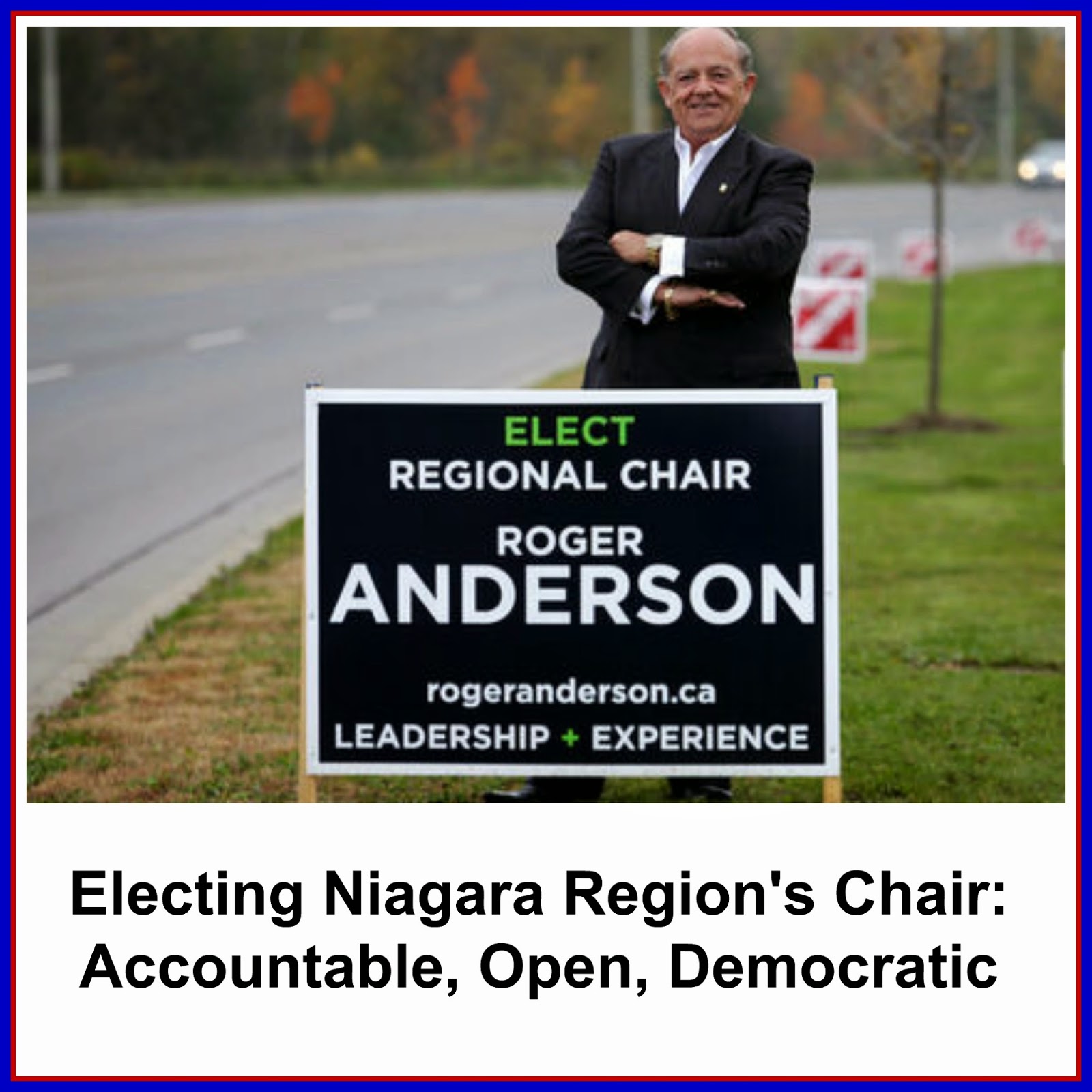
Electing Niagara Regional Chair to Become More Accountable, Open & Democratic
![]() |
| Roger Anderson was victorious as the first elected chair of Durham Region, 2014. |
Role of the Chair:
The full-time Regional Chair sets the legislative and economic agendas for the Region, presides over Council meetings, votes on every committee, and is the “face” of Niagara with Provincial, National, and other governments.
So, while serving as the face of the entire Niagara Region, ironically, the Regional Chair is only accountable to the majority of Regional Councillors.
Baldwin Act & County Councils:
Our current process of appointing a sitting member of Council as chair comes from the Baldwin Act of 1849, which established local County Councils. The names of the annually appointed, former Wardens of Welland County and Lincoln County are etched on two plaques at the Regional HQ (across from Brock University).
When they first created Regional Governments in the 1970s, the Province also appointed the first Regional Chairs. After our first Chair (John Campbell) retired in 1985, Council appointed one of its own as Chair (Wilber Dick).
But, this appointment differs significantly from County Councils days – the new Chair give up his or her seat and is appointed for the entire four-year term of Council.
Lagging Behind Other Regions:
All other Ontario Regional governments have already either adopted a more accountable and democratic process to directly elect their Regional Chair at large or are in the process of doing so.
Waterloo Region (Kitchener, Waterloo, Cambridge, Wilmot, Wellesley, Woolwich, and North Dumfries) began electing their Chair 17 years ago. Halton Region (Burlington, Oakville, Milton, and Halton Hills) has elected a Regional Chair since 2000. Durham Region (Pickering, Ajax, Uxbridge, Oshawa, Whitby, and Clarington) first elected their Regional Chair last Fall.
A bill to elect the York Region (Aurora, East Gwillimbury, Georgina, King, Markham, Newmarket, Richmond Hill, Vaughan, Whitchurch–Stouffville) Chair “at large” is currently before the Ontario Legislature. Finally, in 2013, Peel Regional Council (Brampton, Mississauga, and Caledon) directed staff to report in 2015 on options to directly elect their Chair for 2018.
It’s Time for Niagara:
It’s clear that the way in which Niagara Region currently appoints our Regional Chair is antiquated, undemocratic, and out-of-synch with all other Regions in Ontario.
That’s why I am making a motion at Regional Council on Thursday to begin the process to change toward a directly elected Chair. If you agree, please contact your Regional Councillor.
Let's work together now to become more open, transparent, accountable, and democratic in Niagara!
Subscribe to:
Posts (Atom)