Showing posts with label Ontario. Show all posts

Tuesday, February 12, 2019

What’s the Problem, Regions?

In most regions across Ontario, the issue of governance reform and better service delivery has been discussed extensively over the last 50 years. Since the Province imposed Regional Governments in the late-1960s, various local Councils have debated numerous reports on governance and reform and various Provincial Governments have studied “who does what.”

The Harris Government imposed significant changes in the late 1990s as they forced several amalgamations and “downloaded” billions of dollars worth of Provincially mandated responsibility onto Cities and Towns. While the McGuinty / Wynne Governments “uploaded” many services back to the Province’s responsibility and coffers, they largely stayed away from other reforms.

More recently, however, the Ford Government reminded us all that “municipalities are creatures of the Province” when they cut the size of Toronto City Council from 47 to 25 and cancelled four Regional Chair elections last July.

And, as promised last August, Municipal Affairs Minister Steve Clark announced a review of regional governments in January and appointed Michael Fenn (former Municipal Affairs deputy minister) and Ken Seiling (long-serving Waterloo Regional Chair) as Special Advisors.

Home-Grown Solutions?
Niagara’s 12 Mayors released a statement last week stating their “united support for improving governance, transparency and accountability in local government.” They asked for an “…opportunity to present made-in-Niagara solutions through this regional governance review.” Four local Mayors cited opportunities and challenges for reform in the local newspaper: reducing the number of Mayors / Councillors (currently at 126 in 13 municipalities); the need for shared services; communities potentially losing their uniqueness; making local governments more responsive and transparent; affordability; increasing efficiencies and effectiveness; and removing duplication of services.

At the same time the Greater Niagara Chamber of Commerce launched an online survey to measure the pulse of the business community. They ask participants to “prioritize these goals in reforming government in Niagara: single Niagara brand and image; lower municipal taxes; reduced red tape; speed of decision-making by government; more and/or better municipal services (e.g. snow removal, economic development, waste management); increased access to elected representatives; and increased government transparency.”

Other Ontario regional and local government and business leaders are also talking about amalgamation, de-regionalization, going it alone (like Brampton and Mississauga), and a myriad of possible solutions.

Unfortunately, getting into this well-worn quagmire of regional governance debate reminds me of a familiar Yogi Beri quote: “It’s déjà vu all over again.”

So, What’s the Problem?
Yet, it also reminds me of what Dr. David Siegel, Brock University Political Science professor, said in February 2012 during a special Niagara Regional meeting about governance. Dr. Seigel cautioned that before debating the merits of various solutions – like dual-duty Councillors, an appointed vs. elected chair, or amalgamation – Council had best determine the “problem that you are trying to solve.”

Too often people rush to solutions, only to find that either their fast action has unintended consequences or it that didn’t actually help solve their overall challenge. Additionally, groups often get stuck in circular discussions – going around and around and around  – because participants cannot easily identify and map out why they might want to do something or what’s stopping them from taking a specific course of action.

Importance of Problem Definition:
These situations require leadership. Not the “my way or the highway” leader, however. This leader needs to guide people through a process or method of finding and defining problems, solving them, and implementing the new solutions.

And, problem definition remains one of the most important keys to understanding and solving community and business challenges.

A popular statement about this insight has often been attributed to Albert Einstein: “If I had only one hour to save the world, I would spend fifty-five minutes defining the problem, and only five minutes finding the solution.”

Let’s hope the Province’s Special Advisors will work with business and community leaders to invest significant effort in problem definition and use a problem-solving process so that they can develop innovative solutions for local government.

If not, they risk fulfilling another quote oft-attributed to Einstein: “The definition of insanity is doing the same thing over and over again and expecting a different result.”


Dave Augustyn holds a Professional Innovation Advisor designation with Basadur Applied Creativity (www.basadur.com) and served as the Mayor of the Town of Pelham and a Niagara Regional Councillor from 2006 to 2018. You may provide your ideas and feedback to Dave at daugustyn@cogeco.ca or check out his Dave Augustyn NOW columns at www.daveaugustynnow.blogspot.com.

Monday, April 16, 2018

Pelham’s 2018 Blended Residential Taxes Up 1.9% -- 12 Year Increase Less Than Inflation

If you pay your property taxes by installments, you will know that the second installment of your 2018 property tax bill comes due in two weeks (April 30). With this deadline approaching, I wanted to tell you about Pelham’s 2018 blended residential property tax increase – at 1.9% – and also to compare with other Cities and Towns.

You will recall that the amount of property tax you pay to the Town of Pelham, to the Niagara Region, and to the Province (for Education) is not solely based on the Market Value Assessment of your property by the Municipal Property Assessment Corporation (MPAC); one must multiply your assessment by each of these three tax rates and add them up for your total bill.

With both the Region and the Province making some policy changes and adjustments for rates and tax ratios, we now know that the combined property tax increase for an average residential property (which is valued at $328,138) in Pelham will be 1.9% for 2018. That means an average residential tax bill of approximately $4,187 or an increase of about $79 over last year. (Because of some rates changes, that’s actually a bit lower than the 2% to 2.3% range that I reported to you in February.)

You can consider this $79 or 1.9% a “pocket-book” increase – an increase in the amount it cost an average residential property owner because it’s adjusted for the average MPAC increase in Pelham.

Since Pelham’s portion of your property taxes represents roughly 39% of the total bill, the Town will make use of about $1,618 of the $4,187 for the average residential property.

Who gets the most? The Niagara Region will get about $2,012 or 48% of the total amount. Meanwhile, the Province will receive the remaining approximately $558 (or 13%) to help fund education.

How do we measure whether the increase is “affordable” or not?

One independent way to judge whether Pelham’s taxes are “affordable” is to compare with inflation. For example, the Bank of Canada calculated that, over the last 12 years (February to February), inflation increased the value of goods and services by 22.7%.

Over the same period, Pelham’s combined taxes for the average residential property increased by 22.0% – a bit lower than inflation. Essentially, that means that the average home is paying the same level of taxes in 2018 that they did in 2006!

And, this 22.0% over 12 years includes so many improvements in our community – from renewed Downtowns in Fonthill and Fenwick, to new Fire Halls in Fenwick and North Pelham, from nine renewed playgrounds, to a new skatepark and a new dog park, from a renewed Maple Acre Library to a renovated Old Pelham Town Hall, from 15 km of new sidewalks and 5 km of new trails to the new Meridian Community Centre. And, the list of other infrastructure and services goes on and on.

Another way to judge would be to compare with other Niagara Cities, Towns, and Townships.

Last Fall, the Region published a corrected table of non-blended property tax increases from 2010 to 2017 for local municipalities. If you start at zero in 2010 and add up the cumulative increases, Niagara Municipalities increased their property taxes an average of 35% over those eight years.

Pelham stands as the forth lowest because ours increased 30% – including an increase in funding for the Community Centre in 2016. That’s 14% below the average increase of other Cities and Towns for the same period. Three other growing Towns – Grimsby, Niagara-on-the-Lake, and West Lincoln were lower than Pelham since 2010.

Pelham Council and I continue to work together with staff to ensure that changes in property taxes only minimally impact you and your neighbour while improving the level and quality of services in the Town.


Please check out historic charts or read past columns at www.pelhammayordave.blogspot.ca. Please contact Mayor Dave at mayordave@pelham.ca.

Monday, August 21, 2017

Fonthill Kame, Ridgeville, Strategic Funding & GO Rail at AMO Conference

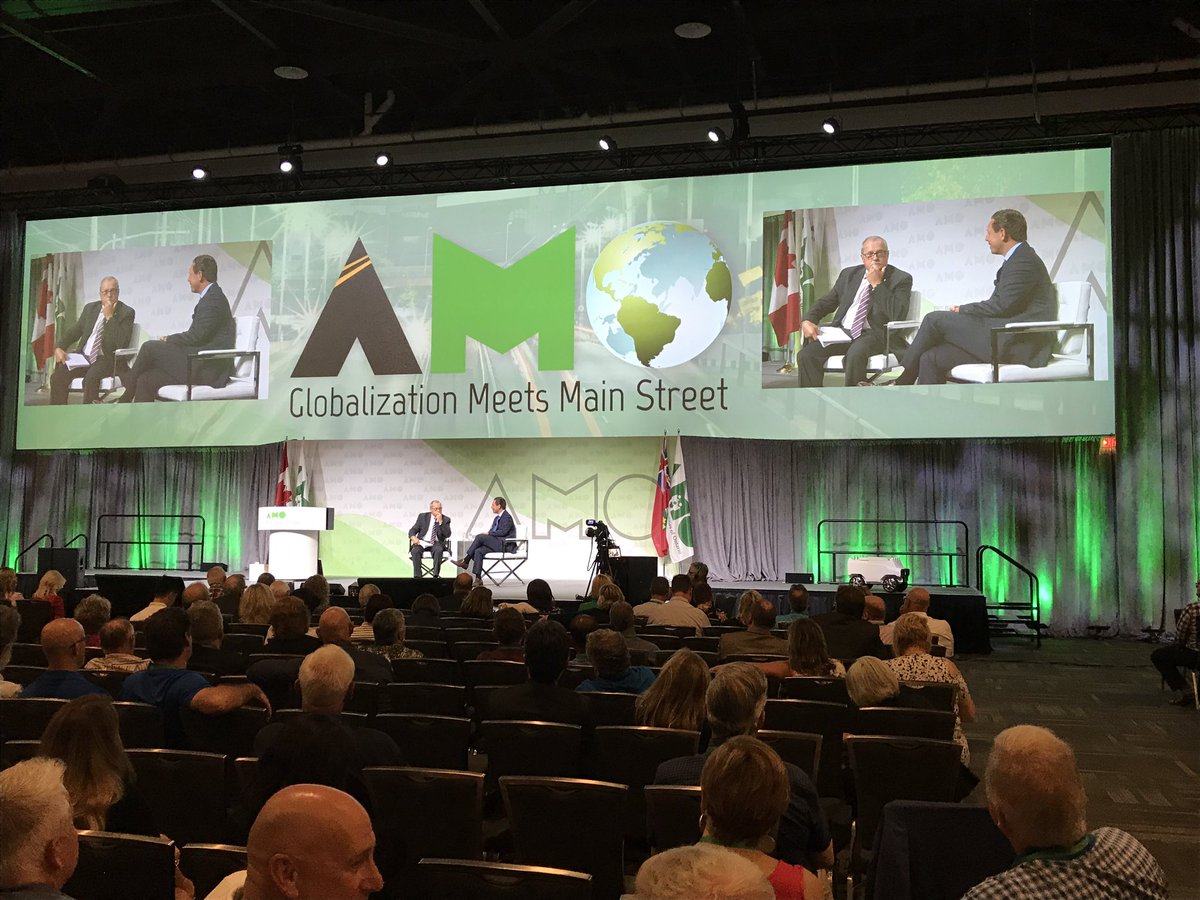
Last week, Councillor Papp, Town CAO Ottaway, Treasurer Quinlin, and I attended the Association of Municipalities of Ontario (AMO) Conference in Ottawa. The annual three-day conference offered a range of learning sessions and networking opportunities for the more than 1,500 delegates.

While at AMO, your Pelham representatives also met with various Ministries to directly advanced your interests with the Provincial Government.

(Photo credit: AMO)
We met with Kathryn McGarry, Minister of Natural Resources (MNR), about increasing the protection of the Fonthill Kame. For the last nine years, we effectively used AMO and “Niagara Week” meetings to urge the Province to enhance the Area of Natural & Scientific Interest (ANSI) protections of the Kame. For the last couple of years we thanked the Provincial Government for finalizing those protections in late 2013. Now, we asked to work together with MRN Staff to add more of the Fonthill Kame to the protections offered by the Niagara Escarpment Plan.

We also thanked the Minister for recognizing the historic hamlet of Ridgeville during the Greenbelt review. Now that the Government fixed this Greenbelt error, we will work together with the Region and Province to delineate, re-designate, and re-zone the “rural commercial” / boutique Ridgeville area.

We also met with Daiene Vernile, MPP & Parliamentary Assistant to Minister of Transportation (MTO), and with Grant Crack, MPP & Parliamentary Assistant to the Minister of Agriculture, Food & Rural Affairs, about funding for municipalities. We encouraged the government to fund municipal projects that help create wealth and prosperity for a community; we spoke not only about projects like downtown revitalizations but also community and cultural facilities like community centres and libraries. We also discouraged the government from investing in projects that create more sprawl – like urban boundary expansions or “smart centers” disconnected from community.

We listened to the three party leaders discuss and dismiss the AMO idea of a 1% increase in the HST to help fund municipal infrastructure.

Shockingly, one party leader also spouted a lie that needs to be quashed. Mr. Brown, leader of the opposition, told the hundreds of delegates that the Government broke their promise of extending GO Rail to Niagara. Later, the PC Party Press Office cited a 2014 quote from Jim Bradley, St. Catharines MPP, in which he stated that he thought the government would announce Niagara GO in 2015.

However, since the Region failed to deliver the case for support for GO Rail to the Premier by the end of 2014 (as she requested), how can anyone blame the government for inaction? In fact, because we delivered the business case after they finalized their 2015 budget, the Government and Metrolinx made the announcement for GO Rail to Niagara at their first opportunity – in the 2016 Budget. Since that and the formal announcement in June 2016, the Government and Metrolinx have continued to work on expanding GO Rail to Grimsby in 2021 and St. Catharines & Niagara Falls in 2023, as promised.

You may contact Mayor Dave at mayordave@pelham.ca and view past columns at www.pelhammayordave.blogspot.ca.

Sunday, September 18, 2016

Assessment Only Half the Picture


Have you received your new residential property assessment notice from MPAC – the Ontario Municipal Property Assessment Corporation? (If you own a farm, business, or multi-residential property, you should receive your assessment mid-October.)

Updated for the first time since 2012, your notice will outline MPAC’s determination of the market value of your property as of January 1, 2016.

MPAC considers many factors when assessing property values, such as the sale prices of comparable properties in your neighbourhood, and the age, location, characteristics, and size of your property and home. In essence, MPAC strives to base their value on the amount your property could have sold for on the open market.

Just like in 2012, property assessments will remain the same for the next four years – from 2017 to 2020. However, if the value of your property increases, that increase will be phased in over the four years; if the value goes down, you will immediately see a reduction.

For example, if the value of your home increased by $20,000 over its current assessment, the value for determining your property tax will increase by $5,000 per year over the next four years.

If the value of your home goes up, does that mean that your property taxes will also go up?

No, not necessarily. Market Value Assessment is only one half of the property tax equation. The amount you pay to the Town of Pelham, to the Region, and for Education is based on the Market Value Assessment of your home multiplied by the three tax rates and added together.

Say the Town budgeted for revenues of $10 million from property taxes in 2017. If all assessments double, the Town would cut the tax rate in half to collect that $10 million. If everyone’s assessments went down, we would increase the rate to collect the same $10 million.

But, what if your assessed value increases more than the average?

The property tax system is a bit of a blunt instrument. Municipalities set the tax rate based on the average assessment for each of the tax classes – residential, multi-residential, commercial, industrial, farm/managed forest, pipelines.

If your property’s assessed value increases more than the average, you will likely pay more than the average tax. By the same token, if your assessed value increases less than the average, you will likely pay less tax.

What if you don’t think the MPAC assessment on your property is correct? You can issue a “request for reconsideration” before November 30, 2016 for residential properties so that MPAC will review your assessment. (Owners of farm, business, and multi-residential properties must file reassessment requests 120 days from the assessment issue date.)

Please check out MPAC’s website (www.mpac.on.ca) and your notice for more information.

Monday, February 29, 2016

Provincial Budget Good News for Niagara & Pelham

Finance Minister Sousa presenting the
2016 Provincial Budget, February 25.
There was a lot of excitement across Niagara and in Pelham last week following the release of the 2016 Provincial Budget.

First, in their Budget, released last Thursday, the Provincial Government committed to extending GO Rail service to Niagara. After submitting our formal business case last spring, all are thrilled to have this commitment in a significant Provincial document.

The budget states: "Subject to agreement with freight rail partners, two-way, all-day rail services on the. Kitchener and Milton GO corridors, and extension of GO rail service to Niagara and Bowmanville."

It’s as if the oft-repeated phrase of my colleague, Niagara Falls Mayor Jim Diodati, came true: “It’s not a question of ‘if’ GO rail comes to Niagara, it’s a question of ‘when’!”

And, while we don’t yet know when, Minister Jim Bradley, MPP St. Catharines and huge GO Rail Niagara advocate, explained last week that Transportation Minister Del Duca will provide more information before the end of June.

As we wait for that, we should keep in mind that it will take some time to get the Niagara GO business plan up-and-running. At best, the Province and Metrolinx could take some interim steps as early as next year; however, property acquisition, station construction, and track refurbishment for a run all-the-way to the Falls will take a couple of years. And, I wonder whether the opening of the Stoney Creek GO Station in 2019 will impact the plan for Niagara.

So, while we must keep pushing for GO Rail, I believe this announcement allows us now to concentrate on developing an integrated regional transit service. With our spring 2017 deadline approaching, I was pleased that the Region, in partnership with Welland, St. Catharines, and Niagara Falls, issued a request for proposals last week to help develop an integrated service.

Second, small municipalities like Pelham (with populations under 100,000) also heard great news in the Budget.

The Province announced it would triple – from $100 million to $300 million – the Ontario Community Infrastructure Fund (OCIF) by 2018-19. This fund will provide predictable funds for critical infrastructure projects. And, importantly for Pelham, we also heard that the Province will no longer penalize growing municipalities with good fiscal records. You will recall that Pelham lobbied the Province for this change since they denied us funding last year because of our community’s high property values and high-quality infrastructure compared to other Towns.

The Province also committed to match the Federal government’s $272 million commitment for the jointly administered “Small Community’s Fund” to “help address local priorities and support economic growth.”

On behalf of Council, I thank the Province for the commitment to Niagara GO Rail and support of small communities like Pelham.